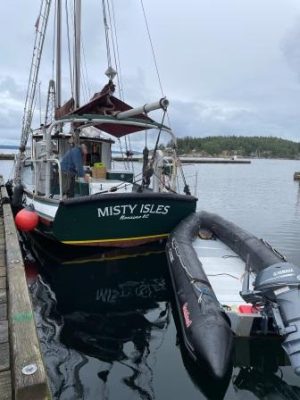
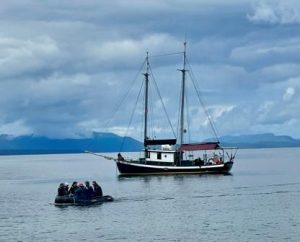
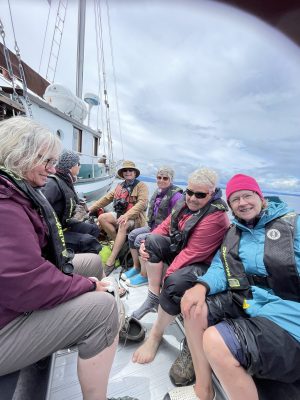
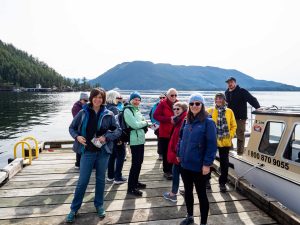
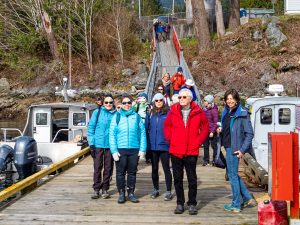
We had eleven passengers from our club, Jonas (our skipper), and George (our guide and naturalist) for our trip to Mitlenatch island.
Our Ride: The Misty Isles. D. Stubbs
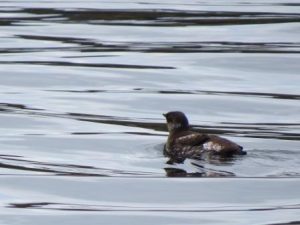
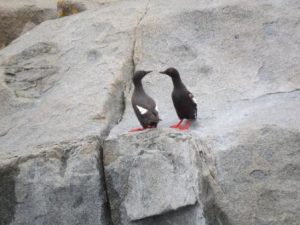
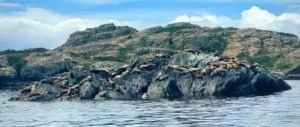
We departed out of Lund and slowed down to observe the wild life on Major rock. There were a number of California Sea Lions, Seals, Cormorants, and Gulls on the island. We also saw Marbled Murrelet, Pigeon Guillimots on the water.
Marbled Murrelet. W. FerrierPigeon Guillemots. W. Ferrier
We carried on, passing between Cortes and Hernando island, while George told us stories about the islands.
Upon reaching Mitlenatch Island we observed a large colony of Steller Sea Lions resting on the rocks. The big dominant male was on the highest point with the females and younger sea lions below.
Steller Sea Lions. L. KnightMisty Isles Anchored off Mitlenatch. L. Knight
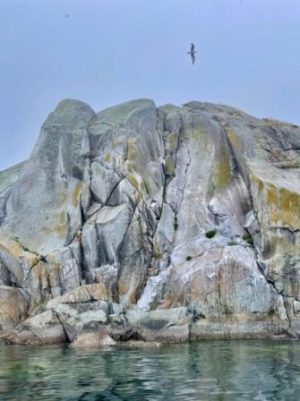
Going around the island to Northwest bay we saw Pelagic and Double-crested Cormorants nesting on the high cliff edges
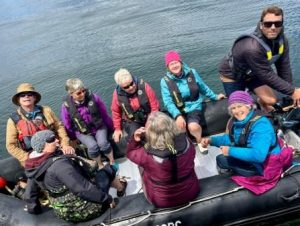
One Group on the Zodiac. K.AlexanderA Second Group Heads around Mitlenatch. D. StubbsCormorants on the Rocks. L. Knight
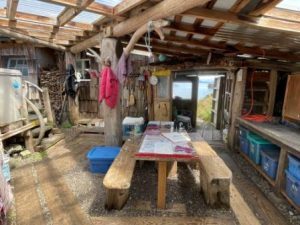
We came ashore in Northwest bay by Zodiac and were guided to the Wardens’ cabin following the designated trail.
The Volunteers’ Cabin. D. Stubbs
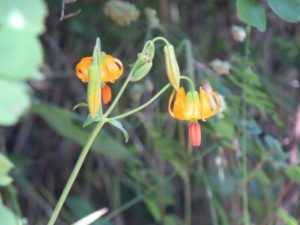
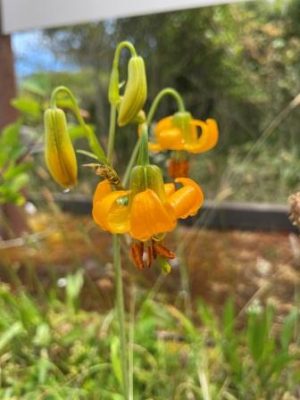
There were lots of tiger lilies and smaller amounts of other flowers blooming.
Native Tiger Lily. W. FerrierNative Tiger Lilies. D. Stubbs
We met the volunteer Wardens, who told us some of their duties.
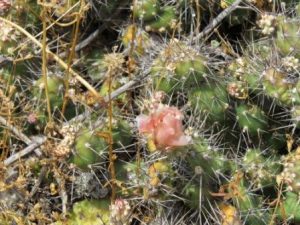
We then walked up to the bird blind to observe pairs of Glaucous Gulls nesting on the rock bluffs. Coming back along the trail we saw patches of Prickly Pear Cactus, with the occasional flower in bloom.
Prickly Pear Cactus. W. Ferrier
This is a really good trip for anyone who is interested in birds and sea mammals!
It was a beautiful sunny morning for an outing as “the early worm gets the bird”. Birding by Ear with Iwan Van Veen at the Wildwood Bluffs. As the group started off there was discussion that bird numbers in general are down all across North America and the world, due to factors such as climate change, pollution, loss of habitat, window crashes, with the number one reason being feral cats.
Listening for Birds. J. Edwards
With the help of Iwan and Merlin bird identification app, we were able to identify and count 42 species. A very good number, as some have returned to the area after the pause on development and destruction in the area.
Some of the audio and/or sighting highlights were:
Orange crown warbler, Evening grosbeak, finches, towhees, robins, wrens, flycatchers, Golden eye, Gold finch, Black throated MacGillivray’s, Sooty grouse, Brown Headed cowbird, woodpeckers, sparrows and a special appearance by the vibrant blue plumage of a male Lazuli Bunting! Also observed were flyovers of eagles, ravens, doves, Band tail pigeons, Turkey vultures and a flock of migrating Snow geese.
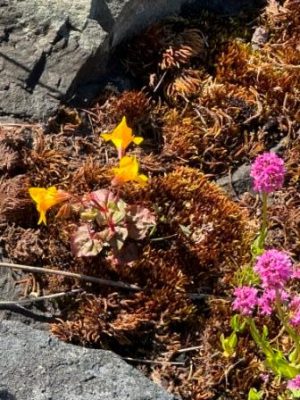
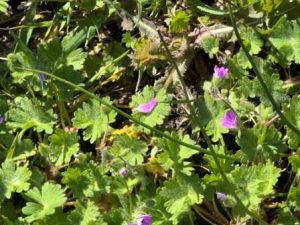
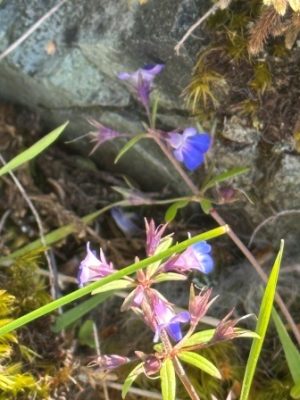
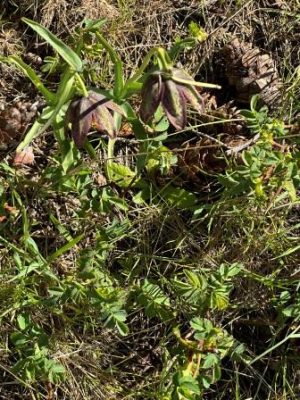
Nine interested members met at the Italian Hall and carpooled to Dinner Rock with Kelly as our leader. First we checked out the flowers on the bluff overlooking Dinner Rock and Savary, where we found Sea blush, Early Saxifrage, Chocolate Lilies, and Dove’s Foot Geranium.
The Bluffs at Dinner Rock. I loveluckSea blush and Monkey flower. I LoveluckDove’s Foot Geranium. I LoveluckBlue-eyed Mary. I LoveluckExploring the Bluffs. I LoveluckChocolate Lily. I Loveluck
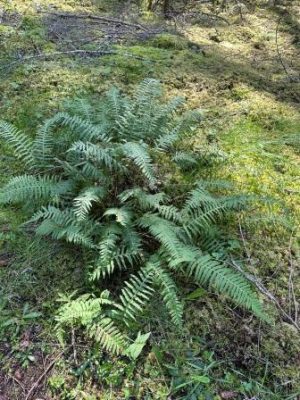
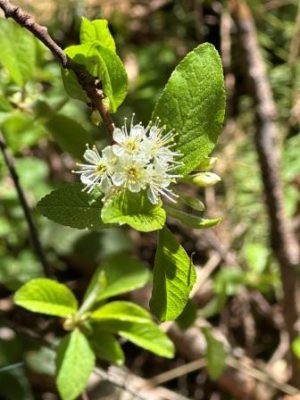
After that, we hiked slowly up to the boundary of the park. It was a gentle climb and we were lucky enough to see lots of Licorice Fern on the way as well as Bitter Cherry just coming into bloom. It is interesting to note that Licorice Fern apparently does taste like licorice and Cherry bark is used by Indigenous Peoples’ weaving.
Licorice Fern. I LoveluckBitter Cherry. I Loveluck
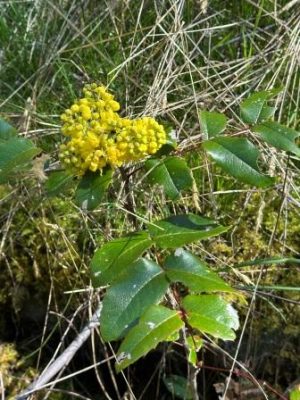
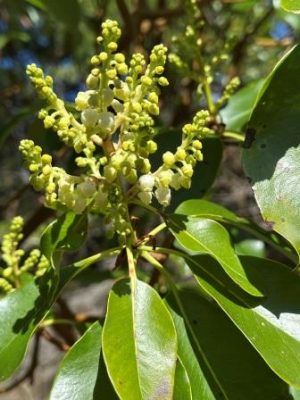
Near the top of the trail we found two types of Oregon Grape as well as Madrona just coming into bloom. Oregon Grape is edible, and the berries were often dried and used as currants. Its roots can also be used to produce a bright yellow dye.
Oregon grape. I LoveluckMadrona/Arbutus. I Loveluck
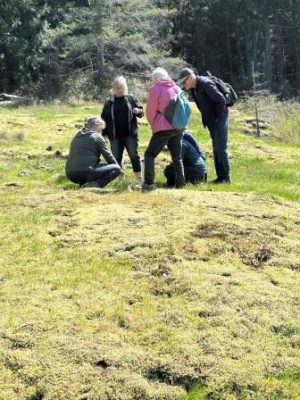
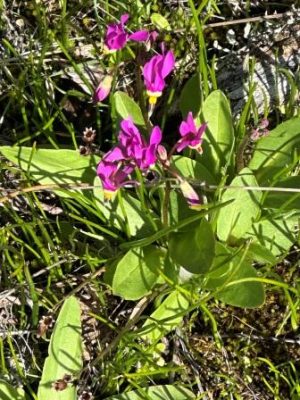
At the top, we found patches of Shooting Stars, two species of Monkey flower, Coastal Strawberry and Kinickinick. We also saw several types of fern.
Examining the flowers. I LoveluckShooting Stars. I Loveluck
We ate lunch on the rocks overlooking Savary (and watched troops of Mergansers diving) and saw more Chocolate Lilies and Blue-eyed Mary.
Lunch at Dinner Rock. I Loveluck
After lunch, the group carpooled down to the Tla’amin Salmon Hatchery to see White Fawn Lily, Fringe cup, False Lily-of-the valley, and Yellow Violet as well as other flowers including the edible Siberian Lettuce.
Kelly, an extremely knowledgeable Botanist who was a previous MalaNat speaker, provided the list below of all the different species we saw:
First stop near the parking lot:
Botanical name
Sea blush
Plectritis congesta
Early saxifrage
Micranthes (Saxifraga) integrifolia
Chocolate lily
Frittilaria lanceolata
Dove’s foot geranium
Geranium molle
Second stop – upper bluffs:
Bitter cherry
Prunus emarginata
Kinickinick
Arctostaphylos uva-ursi
Shooting star
Dodecatheon pulchellum
Wingstem monkey flower
Erythranthe (Mimulus) alsinoides? (still not 100% sure of this)
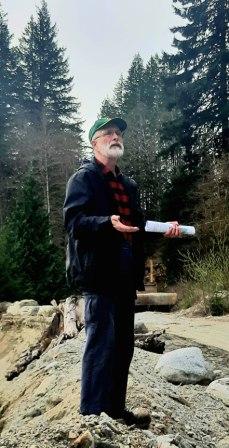
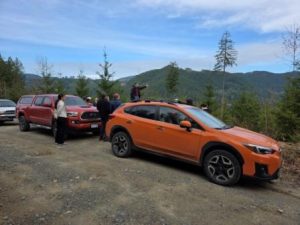
Twenty-one MalaNats members toured the Horseshoe Valley area looking at variety of glaciological and geological sites. And despite some forecasts, the weather cooperated – it turned out to be a nice April day!
Our first stop at 12 Mile on the Goat Main was mostly about recent (10,000 – 30,000 years ago) ice advances and retreats at the close of the last ice age. Some of the sediments left behind as the last ice left the area are nicely exposed in the gravel pit at 12 Mile.
Stop 1: glacial sediments at the 12 Mile gravel pit
Stop 1: Dr. T. Koleszar describing the geology
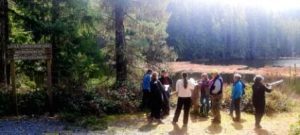
On the Beaver Main we stopped at a view point looking over Dodd Lake and out towards the Rainbow Range. Here we talked a little more about the geographical features left behind by the ice, and also delved into the regional geology and geological history of the area. (And enjoyed the nice view!)
Stop 2: looking over Dodd Lake to the Rainbow Range
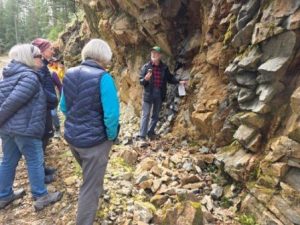
A little further down the road we stopped to hear about fractures and intrusions, and saw swarms of hydrothermal dykes of varying colours. We found the rotten rock that hydrothermal fluids create (and that geologists love to find!) and learned a bit about mineralisation in these veins. We also took a short jaunt down to Beaver Lake to look around.
Stop 3: looking at rocks near Beaver LakeStop 3: dykes and intrusions exposed in the road cut
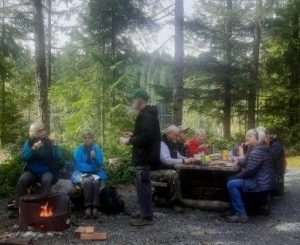
We then drove further up the road to Little Horseshoe campsite where we enjoyed our lunches and warmed up around a nice campfire. Wide ranging naturalist discussions ensued, going all the way from rocks to birds!
Lunch stop: refreshment and a fire at the Little Horseshoe Lake campsiteLunch stop: lots of interesting conversationsLunch stop: and excitement over the mineral samples!
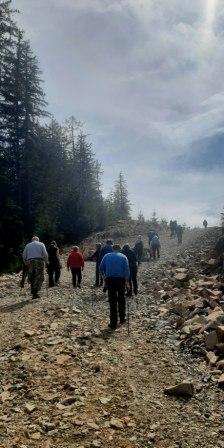
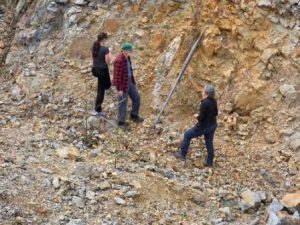
On the way out, we made our last geological stop, walking up an old road to a rock pit where a nicely mineralised quartz vein is exposed. Here we did a bit of hunting for pyrite, chalcopyrite, molybdenite, and other sulphide minerals within the quartz. A few intrepid folk even climbed down into the pit for a closer look at the vein – though, as usual, no one found any gold!
Stop 4: trapesing up the road to a rock pit with a quartz vein exposedStop 4: the mineral hunt begins!Stop 4: down in the pit for a closer look
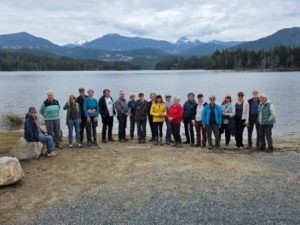
From there we headed towards home with one last stop at Nanton Lake to enjoy the view and compare notes on the day. Hopefully everyone enjoyed the day, perhaps learned a little bit, and maybe even found a few little treasures!
Nanton Lake stop: nice views and a group photo to end the day
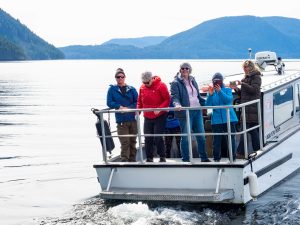
On Monday March 23rd, twenty-three members from the Malaspina Naturalists embarked on a wonderful boat tour with Sunshine Coast Tours from Saltery Bay.
We could not have asked for a better day. The sun was shining and the ocean was calm.
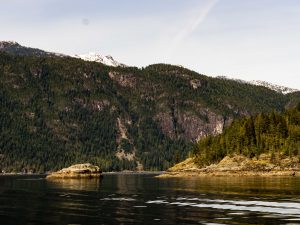
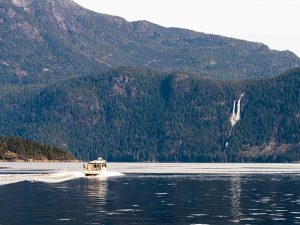
Skookumchuck Narrows Trip 2026-12 T. HallamSkookumchuck Narrows Trip 2026-3 T. HallamSkookumchuck Narrows Trip 2026-5 T. Hallam
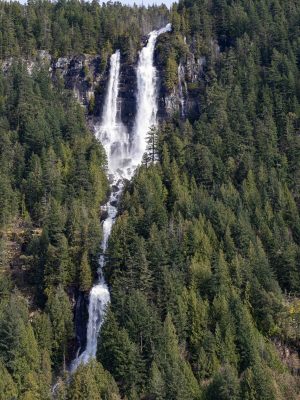
There were two boats that took us on our journey into Jervis Inlet to to the spectacular Freil Falls, a 1,400 foot (427 metre) cascading waterfall, plunging into Hotham Sound.
Skookumchuck Narrows Trip 2026-4 T.Hallam
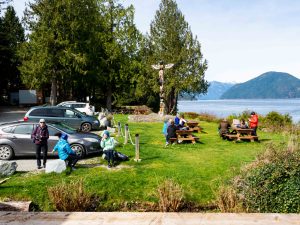
We then stopped for a picnic lunch at the Back Eddie Pub overlooking the straight and then continued on to the Skookumcuck Narrows.
Skookumchuck Narrows Trip 2026-6 T.Hallam
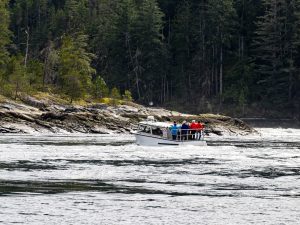
Danny, our tour-guide and skipper, manouvered the currents professionally. He gave us a lot of information and statistics.
Skookumchuck Narrows Trip 2026-9 T.Hallam
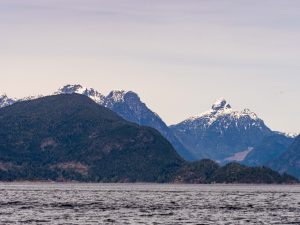
The coastline, wildlife and scenery, along with the snow-capped Churchill mountain range was breathtaking. This was a treasured trip to put in the memory books!
Skookumchuck Narrows Trip 2026-7 T.Hallam
We returned to the wharf four hours later safe and sound.
Rheal Leon is a local scuba diver and underwater photographer. Through still pictures and video he will show us what lives in the Salish Sea right off our local beaches. Linda Diprose, one of our members, will provide the commentary.
LeeAnn Ennis studied Biology at the University of Victoria and the Bamfield Marine Station before her career as a naturalist and interpreter with the Vancouver Aquarium, teaching for B.C. Parks, and here on the Sunshine Coast. She is part of a global effort to restore vital kelp habitat.
ELEPHANT CONSERVATION IN AFRICA – Conservation expert David Powrie has over three decades of experience protecting natural resources and fostering community-led conservation initiatives. He has managed a 6.33 million hectare conservation area in Kenya and introduced endangered species to South Africa. For three years in Africa, he conducted full time research on elephants. He will share insights into their strategic behaviour, communication and family dynamics.
Tammy recently visited THE PANTANAL. Located mainly in Brazil, this is the world’s largest tropical wetland and floodplain. This dynamic ecosystem with a rich biodiversity experiences a yearly cycle of flooding and drying. The Pantanal is known for its abundant wildlife, including jaguars, capybara and various bird species. It is also home to the largest concentration of crocodiles in the world.
Nineteen MalaNats members toured the Horseshoe Valley area looking at variety of glaciological and geological sites. And the weather even cooperated – for November: no sun, but no wind or rain either!
Glacial Sediments at 12 Mile on the Goat Main. B. Kurtar
Our first stop at 12 Mile on the Goat Main was mostly about recent (10,000 – 30,000 years ago) ice advances and retreats at the close of the last ice age. Some of the sediments left behind as the last ice left the area are nicely exposed in the gravel pit at 12 Mile.
On the Beaver Main we stopped at a view point overlooking Dodd Lake and towards the Rainbow Range. Here we talked a little more about the geographical features left behind by the ice, and also delved into the regional geology and geological history of the area. (And enjoyed the nice view!)
Looking over Dodd Lake to the Rainbow Range. B. KurtarLooking at Rocks near Beaver Lake: B. Kurtar
A little further down the road we stopped to hear about fractures and intrusions, and saw swarms of hydrothermal dykes of varying colours. We found the rotten rock that hydrothermal fluids create (and that geologists love to find!) and learned a bit about mineralisation in these veins.
We then drove further up the road to Little Horseshoe campsite where we enjoyed our lunches and warmed up around a nice campfire. Wide ranging naturalist discussions ensued, going all the way from rocks to mushrooms!
Lunch and a Fire at the Little Horseshoe Lake Campsite. B. Kurtar
On the way out, we made one last stop, walking up an old road to a rock pit where a nicely mineralised quartz vein is exposed. Here we did a bit of hunting for pyrite, chalcopyrite, molybdenite, and other sulphide minerals within the quartz. As usual, no one found any gold! From there we headed back home having enjoyed a nice day, learned a little bit, and perhaps acquired a few little treasures!
Dykes and Intrusions Exposed in the Road Cut: B. KurtarQuartz Vein Exposed in a Roadside Pit. B. Kurtar
An intrepid group of fourteen club members set out for the Squirrel Crossing (Duck Lake Trails) parking area in heavy rain. Isabel Loveluck was our leader. We found the parking area surprisingly busy – with people gathering for a multigenerational birthday party. Izi requested use of one picnic table: smart thinking!
Ramaria or Cauliflower? B. Kurtar
She led us to the left first, to an area where lobster mushrooms are often found. She explained these are the result of a symbiosis between a Russula (stalk snaps like chalk) and another fungus, and are recognizable by their bright orange colour and the suggestion of a gill pattern on the underside. Indeed, we found some, but they had been previously cut and left. Several of us collected them anyway. Apparently you can clean them under running water then dry-fry them to drive off excess liquid. I was excited to experiment with cooking them, having tried “lobster” soup at Sarah’s recently.
This is a Cauliflower – we found a Ramaria.
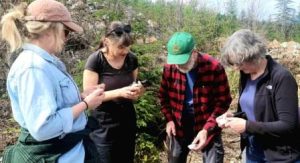
We claimed our picnic table, where Izi pulled out some mushroom samples she had brought. She cuts mushrooms at the base using a sharp pocket knife on a lanyard, and avoids plastic bags as the mushrooms tend to get crushed. One paper bag per species, in a basket. Take the time to key out any new species using a guidebook. If there’s only one mushroom in an area – leave it to grow and release spores. Also, desirable mushrooms can be tapped to release spores before you harvest them. An important safety piece is: never try eating more than one unfamiliar mushroom species at the same meal.
Group Discussion. B. Kurtar
She pulled out a Hideous Gomphidius as an example of an edible gilled mushroom, also noting that there is a Rosy Gomphidius.
Then there are various hedgehog mushrooms which feature soft spines under the cap; the Hawk Wing is one example. Take care as there’s a close relative that will make you sick. (I experienced this while living in the Yukon)
Chanterelles are the tasty yellow mushrooms but they are a bit different because the folds are not parallel and run partway down the stem – important details.
Two of her favourite gilled locals are the Shaggy Parasol and the Prince. Both are in the Agaricus family, like supermarket mushrooms but tastier. The former (not to be confused with a Shaggy Mane) grows in mainly in open areas, and she has managed to “seed” it in her yard by dissolving out spores in water then pouring it into appropriate habitat. Prince can be encouraged by spreading spores under Douglas fir.
Jelly Fungus. J. PadgettTurkey Tail. K. Alexander
Finally, Izi had us wander for a half hour to see what we could find. We spread out and came back with a variety of forest wonders – Russulas (most are edible but not if peppery on the tongue, apparently), Turkey Tail, Little Brown mushrooms (i.e. your guess is as good as mine!) and some even Isabel did not know, but would have to identify using a key and spore print. She handed out black and white spore print sheets and showed us a selection of the best guidebooks for BC mushrooms.
SEPTEMBER 23, 2025
5:00 pm to 7:45 pm
On a beautiful fall evening 11 members met Captain Matt at the Rugged Coast Expeditions truck in the South Harbour parking lot. After some brief instructions we all donned bulky red survival suits and headed out onto the wharf. Our expedition’s boat was a one of a kind ex-military rigid inflatable boat (zodiac) which turned out to be very fast and comfortable.
In our Survival Gear!Leaving the Dock.
We first motored over to the “Hulks” and entered the former mill pond. Here we learned the history of the boats and how they came to Powell River. For a few minutes we watched a noisy group of California Sea Lions who were resting on a long boom. Revving up the motor we headed around the north end of Ahgykson Island and were on the lookout for whales. Matt mentioned that there had been many transient Orca sightings in the past few days so there had not been as many Humpbacks, as they tend to leave the area when the Orcas come in. He reassured us that we should see at least one as there were only two trips this whole season where guests did not see any whales.
Cruising to the Hulks!
We circled Vivian Rocks and observed a group of local Stellar Sea Lions who growl but do not bark like the California Sea Lions. We also saw Harbour Seals and many birds. A whale spout was noticed in the distance and we raced off to that area. We safely observed a female Humpback named Constellation for about 30 minutes as she travelled along.
Matt is a wealth of knowledge about the local history, birds, animals and sea life in and around the waters of the Salish Sea. As we enjoyed a beautiful sunset Matt pulled into a quiet bay on the west side of Ahgykson Island to share more information and stories. It was a magical experience just floating in the fading light and peaceful waters. We headed back to the harbour in almost darkness and our adventure came to an end with all agreeing it had been an amazing trip.
An all day (~0900 – 1500) tour through the Horseshoe Valley looking at various aspects of geology and geography with Trip Leaders Tom Koleszar and Barbara Sherriff. There will be 5 stops throughout the day to explore different aspects of the area such as glacial geography, regional geology, and dyke formation and mineralization in quartz veins. Bring lunch and clothes appropriate to the weather – though we will not go if it is too wet or windy (see storm date). Lunch will be at the Little Horseshoe Lake Rec Site (picnic tables, outhouse, and we will have a fire in the fire pit).
Though the trip is free (except please provide your driver some gas money), it is necessary to sign up. We will need to carpool for this trip, with vehicles suitable for rough logging roads (no city cars!). Please indicate if you are willing to be a carpool driver and provide your contact information (phone and/or email). Carpooling details will be provided closer to the trip date. There will be some walking (<1km) on logging roads.
For our 2025 alpine field trip, we chose a small lake – Vera Lake – on the west side of the Eldred Valley across from Emma Lake. Once again the weather intervened on our planned date (Aug. 9) and we had to move to August 10. However, Aug. 10 turned out to be a fantastic day, sunny and warm with few insects to bother us! We landed on a low ridge near the lake, with wonderful views across the valley to the Emma Lake – Triple Peaks section of the South Powell Divide. Once everyone arrived on site via helicopter, we spent more than an hour before lunch touring around the ridge and lakeshore and learning about the plants, geology, and the alpine environment in general. The area was mostly open with rocks, grasses, and shrubs (lots of heather and small blueberry bushes), and interspersed with patches of mountain hemlock and yellow cedar sub-alpine forest.
Arriving on site in the morning. D. BedryVera Lake in the morning. D. BedryThe group gathering around to start the morning tour. D. BedryThe view across the Eldred Valley towards Emma Lake. D. BedryDiscussing the natural history of the region. D. Bedry
We had no wildlife visitors this year other than a western toad that hopped through early in the morning.
Our morning visitor: a Western toad. T. KoleszarMosses in the morning light. T. Koleszar
After an enjoyable lunch in the sunshine, we had a couple of hours of free time to explore. Some relaxed or explored near the lake, and even went for a swim in the refreshing waters (there was still a snow patch or two at the other end of the lake!). Several people hiked out to a spectacular viewpoint looking over Joan Lake towards Slide Mountain, and an adventurous (foolhardy? it was rather steep!) few even clambered down to Joan Lake for a swim there. It was a great day, and I think everyone had a wonderful time.
Relaxing by the lake at lunchtime. D. BedryEnjoying the cool-but-refreshing waters. D. BedryThe view across the valley to Triple Peaks. T. KoleszarAt the viewpoint above Joan Lake. T. Koleszar. . . and the view over the lake towards Slide Mountain. T. KoleszarThe brave souls who made it down to Joan Lake enjoyed a great swim. T. KoleszarClimbing back up from the lake was “fun”! L. Krepinsky. . . especially since it was somewhat steep! L. Krepinsky
Sharon has kindly created a list of plants she identified on the trip (in alphabetical order):
Alpine aster
Alpine clubmoss and other clubhouses including Creeping clubmoss
Alpine lady Fern
Alumroot
Black Alpine sedge and numerous other sedge
Blueberries – mostly oval leaf blueberry but also bog blueberry
Copperbush
Dandelions
Foamflower
Grasses including hair bent grasses, timber oat grass and many other cousins
Heathers
Lily – likely either yellow glacier lilies or avalanche lily or both (not in flower)
Partridgefoot
Pipecleaner moss and many other moss relatives
Small flowered penstemon
Snow-mat liverwort
And many more!
The happy group! D. Bedry
Thanks again to our drivers who got everyone to the staging area safely and to Cal Smith for handling all the trip registration and communications. And a special thank-you to Ben, our Oceanview Helicopters’ pilot, for his wonderful flying tours on the way in and out and for getting everyone on and off the mountain safely.
This field trip was run for two groups on Saturday and Sunday, July 19 and 20. The trips were aboard a crew boat generously supplied by Western Forest Products, with each following the same itinerary. The trip leaders were Nancy Pezel and Tom Koleszar. The weather was good both days, and we had great views of the surrounding area.
The Saturday group starting up the last reach towards the head of the lake. T. Hallan
Our first stop was near Cassiar Island where Nancy provided some information about the logging and fire history around the lake that has resulted in mainly second growth Douglas-fir forests. Tom discussed how the last ice age created the “fjord” we now call Powell Lake, with its series of deep basins (350+m) separated by shallow sills, and that two basins still have 200m of salty, anoxic water at the bottom.
On route to the next stop, we stopped by Elvis Point for a photo op before Nancy talked about how cutblocks have to meet the Visual Quality Objectives (VQO) designated by the government in scenic areas like Powell Lake. At Olsens’ Landing, we stopped at the old dock which has developed its own floating garden of bog plants, including sundews, Labrador Tea, Bog Laurel, some sedges and a few western red cedar saplings. Here we had a chance to stretch our legs, and also learn a bit about the history of the early farmers in Olsens valley.
The plant life on the old Olsens’ Dock is amazing! T. Koleszar
After cruising to the Beartooth Valley vicinity, Nancy talked about protected Old Growth Management Areas and Ungulate Winter Ranges (this area is a mountain goat hangout in winter). Tom then spoke about the different types of rock in this area compared to other areas of the lake, and how these were formed.
We had lunch at the head of the lake, then walked up the logging road to the bridge over the upper Powell River. It was a hot walk both days, but the views from the bridge were spectacular. Before we left the head, Tom told us some stories of the eccentric characters that once inhabited the area.
The Saturday group at lunch. T. Hallam
. . . and then walking up the road to the bridge viewpoint. T. HallamYes, the rocks around here are mostly granitic. T. HallamThere were nice views of the surrounding mountains on the way. T. Hallam. . . and waterfalls, too! T. Koleszar
The upper Powell River from the bridge. T. Koleszar. . . and now looking back towards the lake. T. HallamSunday lunch at the head while we wait for the rescue boat. T. Koleszar
The Sunday group also had a little extra adventure at the head of the lake as we encountered some mechanical issues with the boat. However, the 2nd WFP crew boat came to the rescue, and the day continued without much change for us.
The Sunday group at the head, ready to embark on the 2nd boat! T. KoleszarThe Saturday group at the head of the lake – everyone is smiling! G. Matheson
On the way back we looked for Rainbow Falls – but there was no water at all in the Falls! We then headed around to a small dock in the Goat Narrows and those who wanted to went for a swim (the water was lovely!). I have to say that the Sunday group far outscored the Saturday group in the number of swimmers! We then continued on the last leg of our journey, stopping off Fiddlehead to hear about the farm and see the octagonal cabin from the “hippy” era that had been skidded down to the lake and is now a float cabin.
The Sunday group catching some sun on the back deck. T. KoleszarOnly two swimmers on Saturday at the Goat Narrows. T. HallamSunday wins – six swimmers! T. Koleszar
Lastly, special thanks go to Geoff Matheson and Ross Nuttal of WFP for their friendly, efficient, and safe piloting through the two days!
Travel with Captain Matt by zodiac (rigid inflatable boat) in the local waters of the Salish Sea. This trip includes wildlife viewing and education, anthropomorphic history, geography and geology pertaining to the area.
Tammy recently visited THE PANTANAL. Located mainly in Brazil, this is the world’s largest tropical wetland and floodplain. This dynamic ecosystem with a rich biodiversity experiences a yearly cycle of flooding and drying. The Pantanal is known for its abundant wildlife, including jaguars, capybara and various bird species. It is also home to the largest concentration of crocodiles in the world.
Travis is a Research Landscape Ecologist specializing in landscape resilience. Focusing on ecosystems which are prone to fire he develops strategies to restore, maintain or adapt forestry landscape for reduced vulnerability under climate change.
Terry calls himself a “Amphibiographer”; a contradiction of “Amphibious Photographer”, telling stories of life at the interface of land and water, a dynamic realm which combines the familiar above water environment people are used to viewing, with the seldom seen underwater world in our local liquid. Wearing a wetsuit or boots, he explores the ocean, fresh water and ditches with his camera resulting in pictures and videos of the amazing life within.
On Saturday, April 5 the Malaspina Naturalist Club was treated to a tour of the Powell River Community Forest by Forest Manager Chris Laing, along with Community Forest board members Rod Tysdal and Janet May.
Setting up at Duck Lake. Photo: T. Koleszar
We all gathered at the bridge by Duck Lake where we received an excellent introduction to the Community Forest, with a lots of information and excellent displays.
Chris Laing and Rod Tysdal providing an overview of the Community Forest. Photo: T. Koleszar
From there, the trip consisted of 4 more stops looking at everything from current harvest activities through various stages of regrowth, and finally to planned new harvest blocks. We learned about all the planning and thought that goes into harvest operations – what to harvest, what to retain, what to plant for the next generation, etc.
Chris explaining what goes into planning and executive a harvest. Photo: T. KoleszarArriving at a recently harvested block. We travelled in six pickups! Photo: T. Koleszar
A lot of questions were answered as we walked through the block. Photo: T. Koleszar
At lunch we had a spot with a great view, a newly planted block, and an interesting trial harvest technique that involved taking narrow strips of trees out and seeing how the surrounding forest growth changes.
Rod talking about the new trial harvest method. Photo: T. KoleszarLunch with a view over the Strait to Vancouver Island. Photo: T. Koleszar
The next stop showed an extremely rapidly growing young forest – some sites grow trees really well!
Looking at growth rings with Chris – are the trees responding to more light? Photo: T. Koleszar
The last stop was at a planned new block, where we discussed how forest harvesting interacts with recreational uses.
Learning about the challenges of combining harvesting and recreational uses. Photo: T. Koleszar
All told, it was a fascinating day with a great deal of information provided! Special thanks go to Chris Laing, Rod Tysdal, and Janet May for all the work they put into this trip, and all the questions they answered all day long!
Three of us got together at the Tla’amin Hatchery on April 13th to see the White Fawn Lilies in bloom. We walked along the creek and were soon rewarded with the nice blossoms. There were not as many this year as other years.
White Fawn Lily Photo: D. Bedry
We also saw Bleeding Heart and Salmonberry in bloom.
We then drove to Gibsons Beach to see the Pink Fawn Lilies. A small patch, but a rare find in our area.
Pink Fawn Lily Photo: D. Bedry
By splitting the trip into two days a couple of weeks apart, we were able to take advantage of the different times the flowers bloom. This was also why we had to advertise dates to be arranged. All we can do is to know approximately when to go.
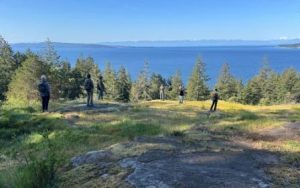
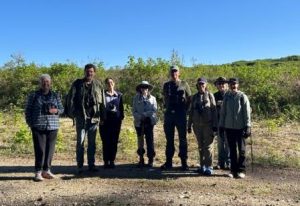
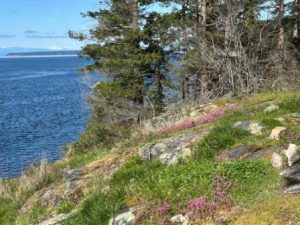
On Thursday, May 29, 2025, thirteen Malaspina Naturalists caught the early ferry to Comox and headed to Vancouver Island. We carpooled to Maffeo Sutton Marine Park in Nanaimo where we had a quick lunch before boarding the small passenger ferry for the fifteen minute ride to Saysutshun/Newcastle Island Provincial Marine Park. Newcastle Island is just minutes from the Nanaimo waterfront and is very close to Protection Island. There are beautiful rock formations along the shoreline and it is very pristine and picturesque.
What started as an overcast sky soon turned sunny and warm. We enjoyed a cool ocean breeze as we followed a lovely wide trail along the coast. We did not see the infamous blonde racoons that inhabit the island, but we did see beautiful towering gary oak, arbutus, cedar and fir trees. A small mouse or vole greeted us around the halfway mark, and we also encountered two large termite hills along the path. They looked busy! There isn’t much evidence of the large-scale underground mining operation that once existed on the island, other than a large ventilation shaft that is now surrounded by forest.
We turned inland and passed by Mallard Lake and then followed the inland forest path back to Mark Bay. There was signage showing the manufacture of limestone wheels which were used to grind wood down into pulp to be used for papermaking. The limestone mined from Newcastle Island was also used in buildings from San Francisco to Vancouver to Victoria.
The museum there was unfortunately closed, but this beautiful island is definitely worth a return trip. In the afternoon we ferried back to Nanaimo, where we carpooled back to Comox for the evening ferry. As we waited to board we were treated to the sight of harbour seals and an eagle perched above us.
Thanks to Cindy for organizing and to Libby for leading us on the trails.
At the Saltery Bay dock, 12 Club members embarked on a Sunshine Coast Tours boat captained by Bryce Christie for an afternoon tour of Jervis Inlet and the Skookumchuck Narrows. The day was mostly sunny, but somewhat cool – there was fresh snow on the mountains!
T. Koleszar
From Saltery Bay we went up into St Vincent Bay,
Oyster farm at St. Vincent Bay T. Koleszar
then across lower Hotham Sound to the Harmony Islands Marine Park and Freil Falls.
The view up Hotham Sound T. KoleszarA closer look at Freil Falls T. Koleszar
The up-close view of the falls was quite spectacular!
A side view of the falls – there was a lot of water! T. Koleszar
We then proceeded across Jervis Inlet to Egmont for a short shore break, and afterwards on into the main event: the Skookumchuck Narrows and Sechelt Rapids!
We passed some seals on a small island T. Koleszar
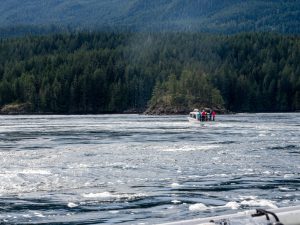
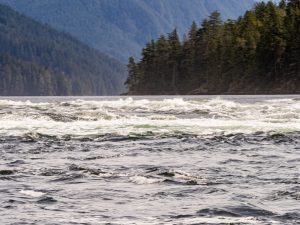
The rapids were flowing at 12 knots, so the waves and whirlpools and eddies were quite amazing.
Looking up the main channel T. KoleszarThe main standing waves T. KoleszarA small channel of the rapids T. Koleszar
The drop in water levels from the top of the rapids to the lower side is very obvious and not what we’re used to seeing on the ocean!
Water level drop in the smaller channel is clear!T. Koleszar
We had just a touch of rain at this point, but the bright rainbow over the eastern shore made up for it.
Rainbow over the eastern shore T. Koleszar
The return trip took us along the shore of Nelson Island and back into Saltery Bay.
It was a great trip and Captain Bryce was a very good tour guide, ably describing everything we were seeing along the way.
The entire group was very happy with their afternoon out on the water, and I think we’ll likely run this trip again soon!
Doors open at 6:45 PM, AGM at 7:15, Speaker at 7:30 PM
Trevor and Colleen, members of the Malaspina Naturalist Club and excellent photographers, spent a month travelling throughout New Zealand, visiting both the North and South Islands. They found beautiful landscapes, stunning seascapes, and many interesting birds that are unique to New Zealand. They learned about New Zealand’s volcanic activity, experienced hot pools, and saw the aftereffects of the Christchurch earthquake in this very seismically active part of the world. Through this presentation we will be able to share their experiences and adventures!