Rambling with Clyde

Rambling with Clyde
By Janet Alred, 10 March 2011. 

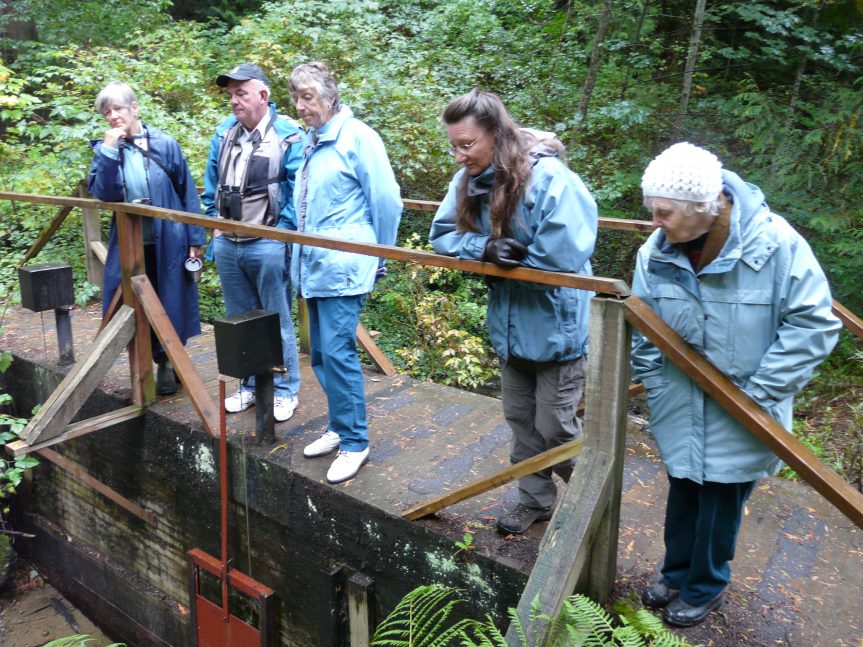
On Thursday, six people dripped their way around the Lang Bay Fish Hatchery where there were no dippers to be seen as they have all gone up to the mountains to breed in the fast water.  We crossed the road to look at the mouth of Lang Creek and on the way saw a killdeer pretending it had a nest, but it was too early.

There were very few birds in the estuary so we drove over to Michael Stewart’s place and hiked her back lanes.  En route we saw and heard an eagle on its nest.  Down on the beach we saw black oyster catchers, mew gulls and glaucous-winged gulls and an Anna’s hummingbird greeted us in Michael’s backyard.
Pat Trask – “Palaeontology and dinosaurs”

Pat Trask – “Dinosaurs”
by Heather Harbord, 24 February 2011

Pat is the curator of natural history at Courtenay and District Museum and Palaeontology Centre.  This centre attracts scientists from around the world, and his tours have helped reveal the secrets of a little-known fossil record.

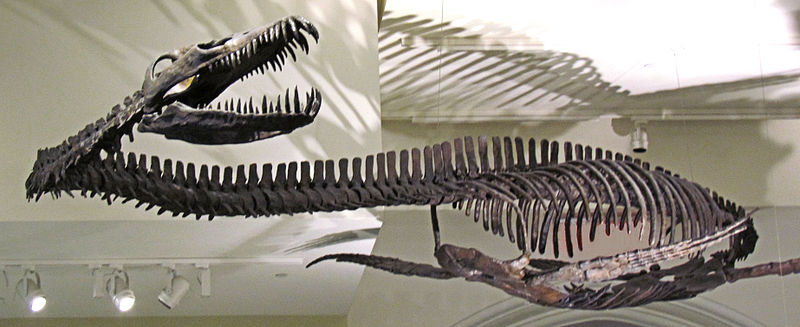
His talk highlighted his many years of hunting for dinosaur fossils along the Puntledge River, and in particular his involvement in discovering a previously unknown elasmosaur – a long-necked marine mammal from the Cretaceous period – with help from his twelve-year old niece Heather!

 The Globe and Mail has an excellent write-up about Pat and his work here.

Forest Greens

Forest Greens
by Janet Alred, 5 February 2011.

On Saturday Wendy Cocksedge, who spoke to us last year about the forest greens used in the floristry industry, escorted four of us along the Willingdon Trail where we identified Scouring rush, Salal, Trailing blackberry, an early Skunk cabbage, small leaves of Sweet Cecily (we think), new Salmonberry shoots, Oregon-beaked moss, Red huckleberry, Sword ferns, Lady ferns, Deer ferns and Frog-pelt lichen.

On the way back, Wendy told us about how tapping Big-Leaf maples for their syrup is becoming a big industry on Vancouver Island.  We also saw some magnificent Harlequin ducks and Red-breasted mergansers in full breeding plumage.  Douglas squirrels chattered at us and one took a peanut almost out of Elizabeth’s hand.

Whales, dolphins and porpoises with Susan MacKay

Whales, dolphins and porpoises with Susan MacKay
by Janet Southcott, 22 January 2011.

The Young Naturalists met at Trinity Hall (United Church). Susan MacKay, who well known in whale circles, returned to teach children all all whales, porpoises and dolphins!

They learned lots, especially about what to do if you see something BIG swimming through our local waters.  Be sure to report your sightings here.

Liz Gillis – “Squirrels”

Liz Gillis – “Squirrels”
by Sherri Wretham, 18 November 2010 

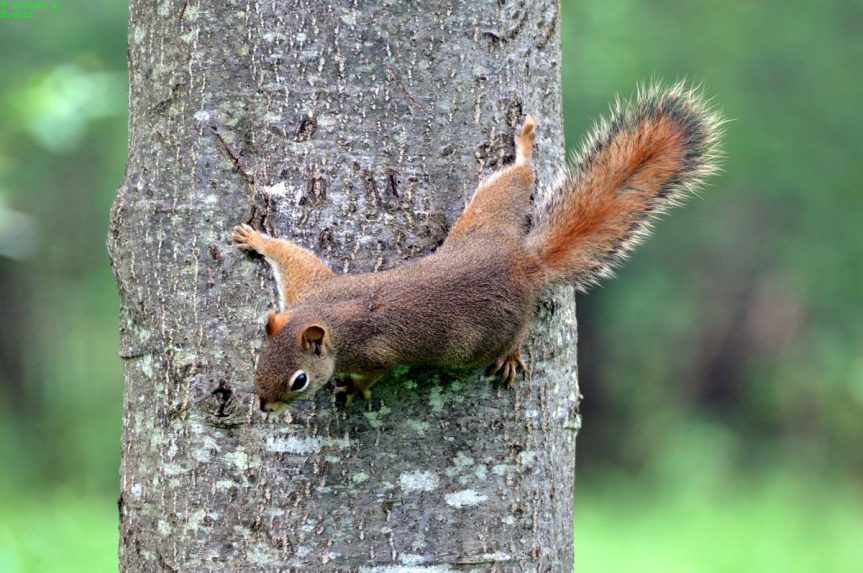
Liz Gillis is a Professor in the Resource Management Officer Technology (RMOT) program at Vancouver Island University in Nanaimo.  Her talk focused on the diversity and behavior of squirrels, and how interesting their private lives really are.

Liz also explored the facts, myths and great unknown about the encroachment and impact of expanding populations of Eastern grey squirrels upon our native Red squirrels.


Winter twigs

Winter twigs with Shirley Cole

by Heidi Rohard
7 November 2010

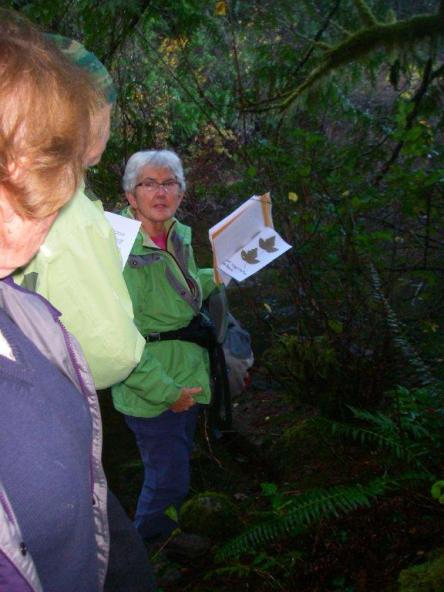
On a surprisingly sunny Sunday morning, Nov. 7th, 2010, nine of us met Shirley Cole in the North mall parking lot. While waiting for departure time she showed us and explained various twigs, some with leaves still attached, as well as a beautiful collection of pressed leaves of shrubs we were going to look for. We carpooled along Duck Lake Road and hiked to Squirrel Crossing, at the Northern end of Duck Lake.

Under the bridge and along the easy hiking trail we found: red huckleberry, saskatoon, Pacific ninebark with its shedding bark, salmonberry, hardhack (also known as steeplebush), red-osier dogwood which has attractive red stems, and silver-grey barked cascara. Shirley almost ended up in pool of standing water reaching for a branch of Pacific crab apple. Finally, on the way back to the bridge, we were happy to see a false azalea bush.

This was a fun outing and, thanks to Shirley, a very informative one. It will be interesting to find these shrubs in the other seasons when they have foliage and berries.

Mushroom workshop

Mushroom workshop
by Janet Alred, 16 October 2010. 

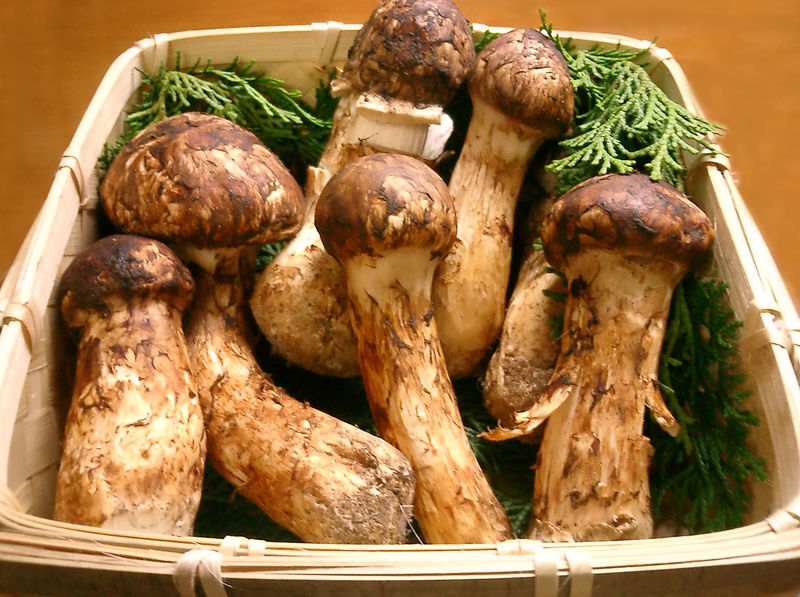
Thirty-three people turned out for the mushroom workshop with Brigid Weiler of Cortes Island.  Brigid’s picture appears on page 145 of David Arora’s All that the Rain Promises and More… This eclectically illustrated handbook is available locally from Breakwater Books along with his larger reference book Mushrooms Demystified.

Brigid brought a few representative species which she talked about briefly before dividing us into groups which were each led by an experienced mushroomer who came with her. We fanned out into the Penticton woods mainly, where we picked for an hour and then returned to the United Church hall. We then spread our collections out on the tables in categories and Brigid talked about them while the group leaders cooked up some of our catches for us to sample. Most were much tastier than store bought mushrooms.

In addition to discussing which were edible and which not, Brigid also showed us several samples of wool died with mushrooms. There were some lovely red, purple and gold colours.  She is a dynamic speaker who would be willing to come again next year.

Texada turtles

Turtles of Turtle Lake
by Heather Harbord, 22 June 2010.

Nine of us gathered at the Lucky Dollar Store in Van Anda on Tuesday to meet with Vanessa Kilburn, South Coast Western Painted Turtle Recovery Project Leader.  She led us along the mossy trail to Emily Lake, also known as Turtle Lake.  There we watched as one of her assistants snorkelled over to some unsuspecting Western Painted Turtles basking on a log on the other side of the lake and caught a female to show us.  We admired her pretty red plastron and wondered if the dark brown patterns on it had inspired First Nations art work.  Vanessa and Aimee Mitchell, Provincial Government biologist, then produced a Slider and showed us the differences between the two species.

As the Painted Turtle had already been through their process they released her back into the water and we watched her swim right back to where she had been caught.  Then they weighed, measured, and notched identification marks on the slider which had a distinctive red mark behind the ear and a yellow plastron.  After examining a leathery turtle egg, we walked round the lake to where the nests were right in the middle of a swimming area.  Tim Atwood, Coordinator of the Texada Stickleback Group, joined us and pointed out benthic sticklebacks swimming close to shore.  We did not see any of the smaller limnetics.  After lunch we drove over to Shelter Point and sat on the logs to enjoy the sunshine before catching the 3pm ferry home.

John Gunton – “Geology of Rivers”

John Gunton – “Geology of Rivers”
by Sherri Wretham, 27 May 2010

Dr. John Gunton worked for resource companies around the world for over 35 years.  He lives in Nanoose Bay, where he continues to practice geology as a consultant.  His career fostered a clear understanding of the earth processes that have shaped the globe over millions of years, and continue to shape our world today.

John  returned to Powell River to share the second part of his series about “Geo-hazards of the Georgia Basin”.   This time he focused on water movement and flood hazards, and explained how water shapes the landscape, and influences our daily lives.

Rick Harbo – “Shoreline Critters”

Rick Harbo – “Shoreline Critters”
by Sherri Wretham, 15 April 2010

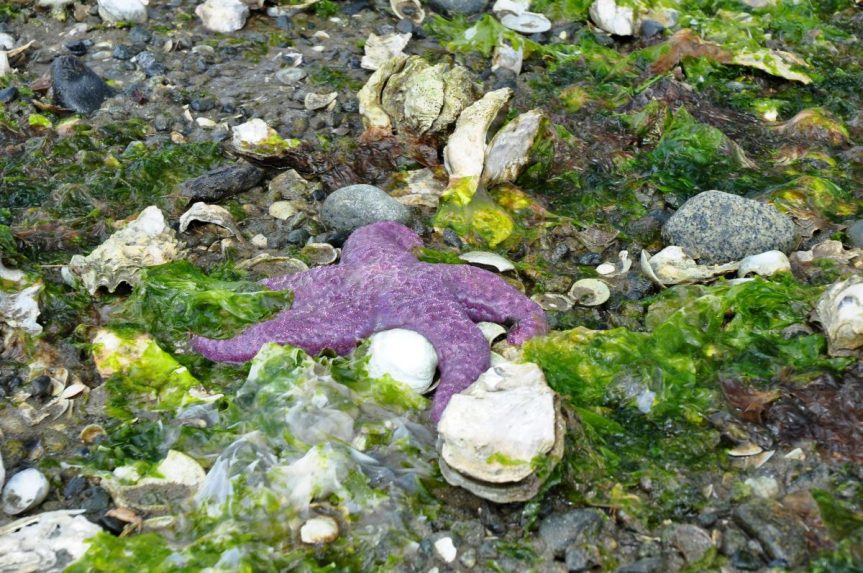
 Rick Harbo is a well-known marine biologist, diver, photographer and author based at the Pacific Biological Station in Nanaimo.   He is the bestselling author of numerous books about intertidal life in the Pacific Northwest, including Tidepool and Reef, The Edible Seashore, Guide to the Western Seashore, Shells and Shellfish of the Pacific Northwest, and Whelks to Whales.   These titles and more can be ordered on-line here.

The subject of his presentation was unsurprisingly, intertidal life, and his lively and knowledgeable talk was accompanied by his stunning photographs.

Susan MacKay – “Whales, dolphins and porpoises”

Susan MacKay – “Whales, dolphins and porpoises”
by Janet Southcott, 15 April 2010

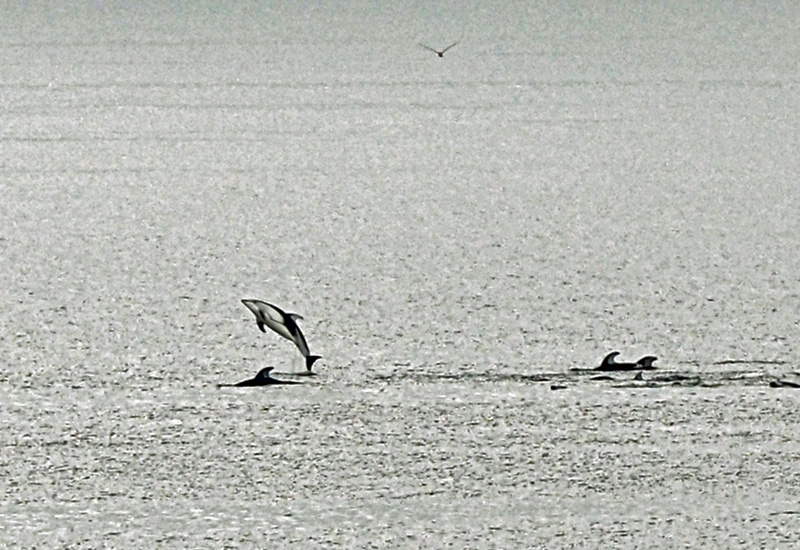
Susan MacKay has worked with local whale, dolphin and porpoise populations for years.  She has collected lots of fabulous pictures and sounds and information about them that she wished to share.   She provided useful information if you happen to see something really big swimming in the ocean along our coast!

Birding by ear Part II

Birding by ear Part II
by Heather Harbord, 10 April 2010.

Ten of us stalked the old golf course at the Townsite with Pierre listening for birds.  It was “briskly cold” but warmed up later. Many of the migrants had flown north after the storm three days ago but there were enough singing for our purposes. The most conspicuous were Song Sparrows, Purple Finches, Spotted Towhees, Varied Thrushes, Yellow-rumped Warblers and Ruby-crowned Kinglets who actually showed off their ruby crowns.  Several sea lions also serenaded us.

As we entered the forest part of the walk, a tiny Winter Wren was carrying some mossy nesting material in its bill and entered in a cavity about 25 feet of the ground in a cedar tree. We watched it poke its head out of the nest and then challenge us with a lively song. A little further along, a Varied thrush and a Robin sounding their alarm notes prompted Elizabeth to look up to see a roosting Barred Owl that we all saw. We ended up with a list of 32 birds which is pretty good. We saw no Rufous Hummingbirds or Turkey Vultures.

Wildflowers

Wildflowers
by Heather Harbord, 3 April 2010.

Led by Shirley Cole and Clyde Burton, six people enjoyed the sunshine after the previous day’s big storm.

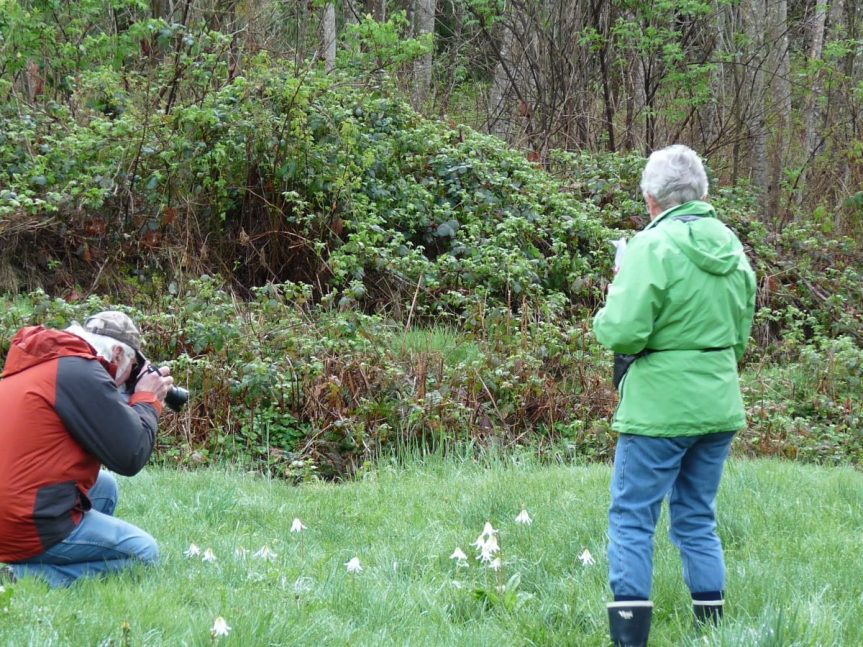
Rod Innes took us to see the white fawn lilies at Sliammon and we then proceeded on to Dinner Rock where we picked up Walter Kubany and looked at shooting stars, blue-eyed Mary, two kinds of monkey flower, pink sea blush, parsley and liquorice ferns and other floral beauties.  The chocolate lilies will be out in another ten days.  Up Malaspina Road we found calypso orchids still in bud and estimated that another week or so would see them in bloom.

Goats, rushing river and a portage

Goats, rushing river and a portage
by Heather Harbord, 28 March 2010.

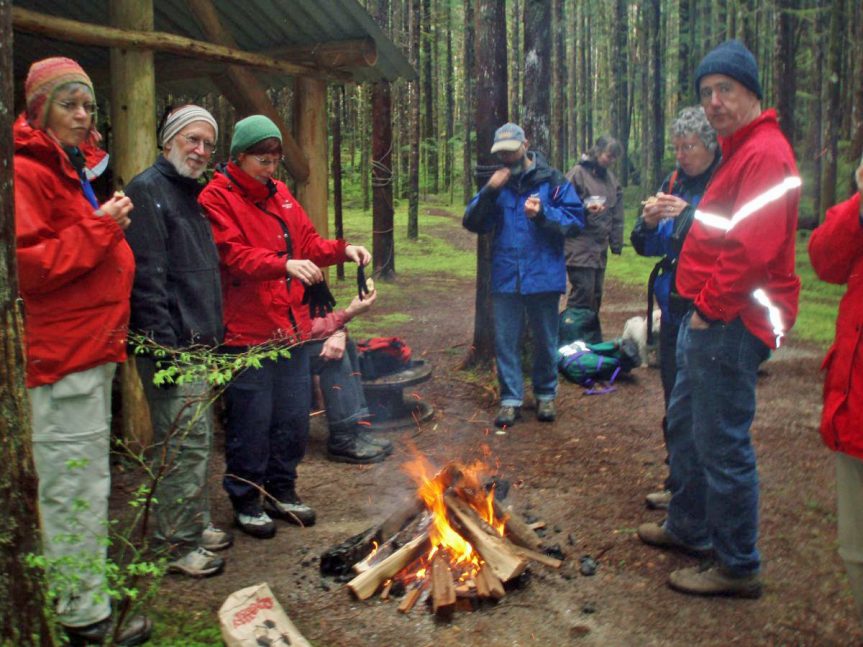
Twenty-two people travelled up the Goat Main as far as Mile 34. Through spotting scopes, we had a clear view of five mountain goats on the bluffs on the other side of Goat Lake.  We continued on to Eldred Falls which was just beginning to flood from spring runoff.  A pair of Dippers exhibited their courtship rituals for us.  Lunch by a fire at the climbers’ camp helped rejuvenate us before we headed back to the Ireland Lake – Nanton Lake portage.

 Clyde Burton continually showed us the signs of early spring. Juncos and a dozen or so golden-crowned kinglets flitted in and out of the shrubs along the portage and a tree full of pine siskins delighted us with their serenade. Out of sight but within earshot were varied thrush, a flicker and a couple of unidentified flycatchers.

Leaders: Owen Gaskell and Elizabeth Tenhoeve.

Kyrie Mann – “Jellyfish”

Kyrie Mann – “Jellyfish”
by Andrew Bryant, 18 March 2010

Kyrie Mann is a local biologist who also works a a guide and kayak instructor.   She grew up here and loves everything about the outdoors.   She spoke to us about jellyfish and their unusual characteristics.

Jellyfish are members of the phylum Cnidaria, which includes predominantly marine invertebrates, and are well known for their sting.  Stinging cells are a defence mechanism and a way to capture prey.

The most common jellyfish encountered here are the red Lion’s Mane jelly (Cyanea capillata) and the translucent Moon jelly (Aurelia aurita).  The former species  is the largest jellyfish known, and enjoys the cool waters of the Arctic, northern Atlantic and northern Pacific oceans.  One specimen (which had a bell of approximately two metres diameter and tentacles 36.5 metres long) was found to be larger than the Blue Whale, making it the largest animal in the world.

The Powell River Peak interviewed Kyrie for a story, which can be found here.

Worms!

Worms!
by Elizabeth Tenhoeve, 27 February 2010.

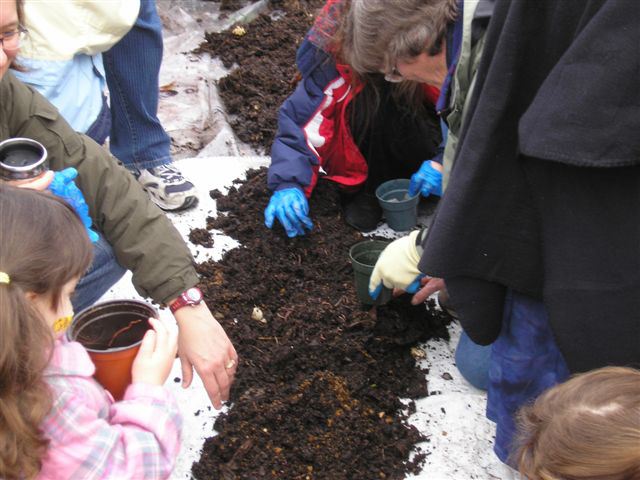
WOW!   What a great time we had playing in the dirt and learning all about worms.  We met at the Community Resource Centre on Joyce Avenue across from the First Credit Union, where there is a worm farm in the backyard.

The folks there have been raising earthworms for their kitchen garden and compost bins and it was time to see how many worms had been raised so they invited our members to come and help with the counting, measuring and weighing of the wrigglers.  Worms are incredible and often overlooked little creatures that serve a purpose by mixing and adding air to the soil.

Heather Harbord – “New Zealand”

Heather Harbord – “New Zealand”
by Sherri Wretham, 25 February 2010

 Our globe-trotting member Heather returned with another slide show of her recent travels – in this case to New Zealand.  As always we remained impressed – and more than a little envious!


Swans of Comox

Swans of Comox
by Heather Harbord, 20 February 2010

Three of us attended this birding field trip.  On the ferry to Comox, numerous long-tailed ducks and murres were sighted. At Little River, we stopped to see the shorebirds just outside the terminal. A large flock of dunlin were interspersed with black-bellied plover, mew gulls and glaucous-winged gulls. By the airport, we saw whistling swans swimming in a slough with some mallards.

At Goose Spit, several pintails were enjoying a muddy meal with more mallards. We got close enough to a small group of white-winged scoters to see the red tips on the ends of their beaks. Usually they are too far away for us to see this handsome detail. Clyde explained that when they dive, they swallow mussels whole and their digestive juices then open the shells which are afterwards regurgitated empty.

At the nature observation point on the dyke road, we saw about 5-6 European widgeon along with a few of their American cousins.  Usually we expect to see about one European to 100 American but this was more like a 1:10 ratio.  We drove as far as Oyster Bay where we saw more dunlin and other shore birds.  On the ferry ride back, we saw several common loons and more long-tail ducks.


Lichens revisited

Lichens revisited
by Heather Harbord, 30 January 2010

The Lichen trip was so popular that those who couldn’t attend asked for it to be repeated.  This we did at Ann and Paul Clements’ house, followed by a field trip to Haslam Lake. Five people attended.

Robb Bennett – “Spiders”

Robb Bennett – “Spiders”
by Sherri Wretham, 28 January 2010

Robb Bennett is an entomologist who has studied the natural history of spiders for many years.   His interest has taken him around the world, and his collected specimens reside in many museums.  Robb formerly worked as a researcher with the BC Ministry of Forests, and was the editor of the Canadian Entomologist (2007-2011).

Now semi-retired, Robb welcomed us into the strange predatory world of spiders, where females rule and males must tread carefully!

Lichens

Lichens
by Ann and Paul Clements, 9 January 2010.

Seven members attended.  The trip started at Community Living Place at 10am with a review of the biology of Lichens.   As a framework for identification in the field, we then reviewed the seven Lichen classifications described in Pojar and MacKinnon’s Plants of the Pacific Northwest Coast.

The group viewed examples of lichens in each of the seven groups and examples of lichen features such as apothecia, soredia and isidia. We then carpooled to Haslam Lake and viewed many varieties of lichens found at the site.   The trip was led by ourselves and concluded at 12:00 noon.


Naked eye stargazing with Christine Woolcott

Naked eye stargazing with Christine Woolcott

by Janet Alred, 12 December 2009. 

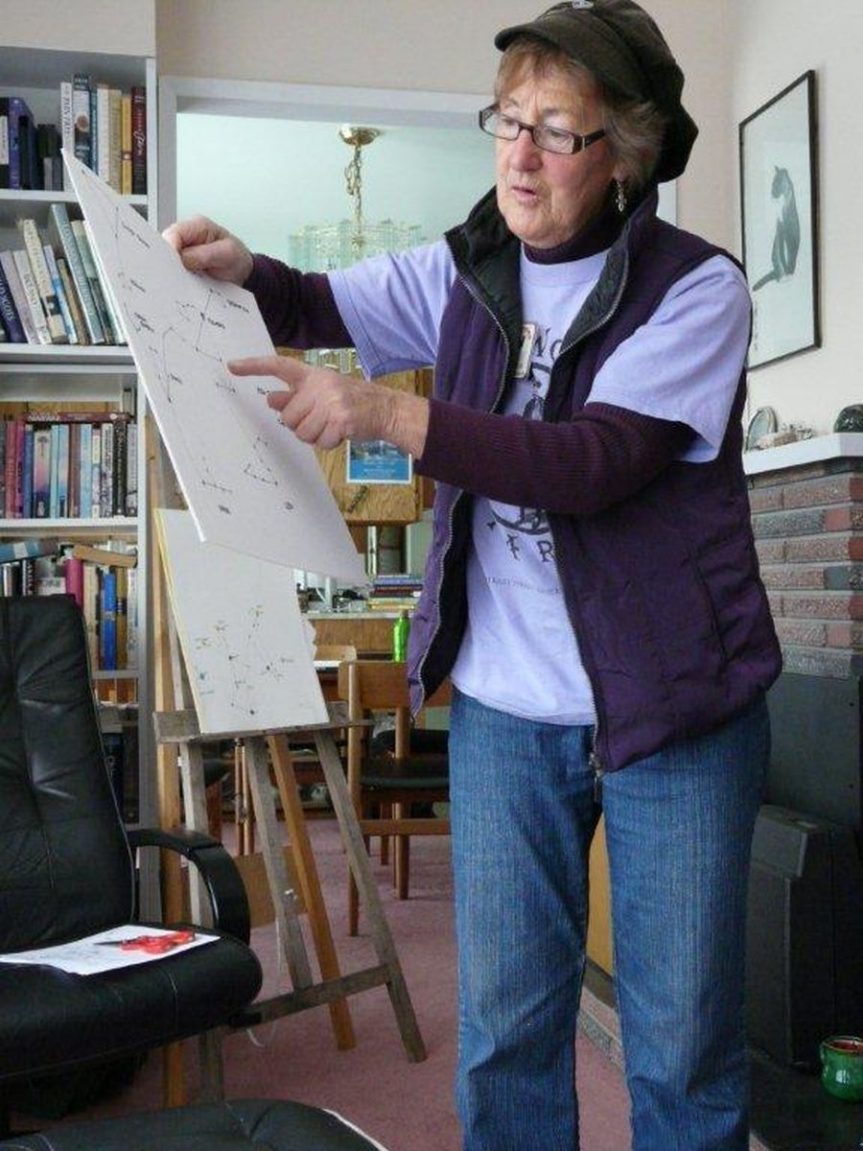
The Young Naturalists Club hosted a workshop for children and families about the night sky at Trinity Hall, United Church.  Stargazer Christine Woolcott led the children through creating a constellation map.

Wendy Cocksedge – “Non-timber Forest Resources”

Wendy Cocksedge – “Non-timber Forest Resources”
by Sherri Wretham, 19 November 2009

Wendy Cocksedge is a club member and is also affiliated with the Centre for Non-timber Forest Products, located at Royal Roads University in Victoria.

Wendy spoke about non-timber forest products (NTFP), which in layman terms are items and services that can be commercially harvested from forests and other habitats for culinary, nutritional or therapeutic purposes. In BC this primarily means mushrooms!

The wild mushroom harvest contributes millions of dollars to the provincial economy.  The pine mushroom (Tricholoma magnivelare) is by far the most valuable commercially harvested mushroom.  Other valuable mushrooms include chanterelles, morels, lobsters, boletes, cauliflowers and hedgehogs.

Wendy also mentioned other commercially important species such as salal (Gaultheria shallon), which is widely used in the floral industry.


Salmon, Eagles and Waterfowl

Salmon, Eagles and Waterfowl
by Heather Harbord, 14 November 2009.

On Saturday, nine members carpooled from the Liquor Store parking lot and drove out to the Sliammon Hatchery, picking up a north-of-town member on the way.  The person Clyde had arranged to show us around wasn’t there. Instead, he and Susan did the honors assisted later by a gentleman who was helping to dry some fish. The latter opened a tank full of coho and we admired their colours and saw some of their eggs.

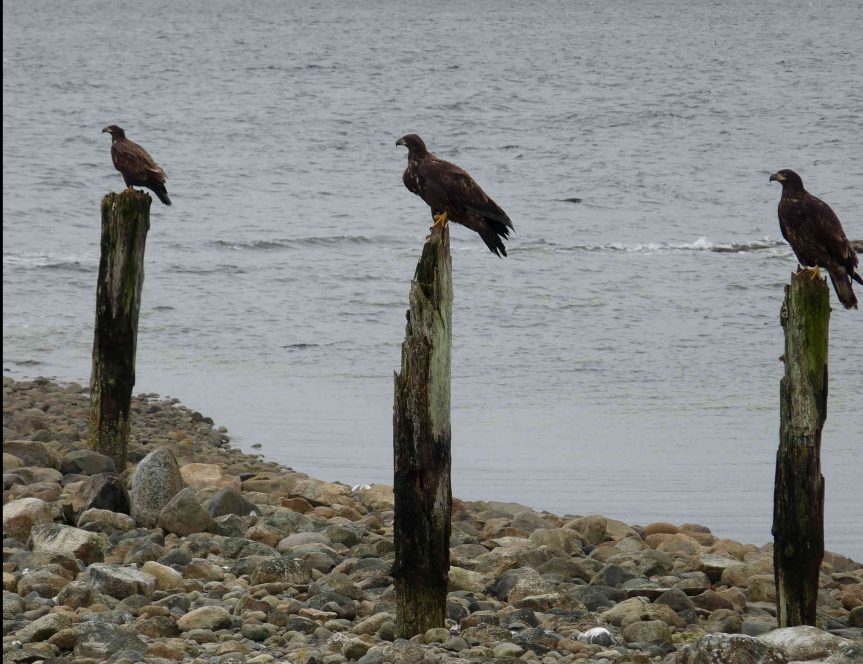
Down at the viewing area, we went nose to nose with a chum salmon. With permission from the lady drying the fish, who also let us taste some samples, we proceeded down to the end of the road where the creek comes out. Three immature eagles posed on three posts while Clyde explained that females are 1/3 larger than the males. Other immature eagles on the rocks brought the total up to about 10. After a short discussion on gulls, we left before we froze.

Heather Harbord – “The Ice Was All Around: natural history from the deck of an icebreaker”

Heather Harbord – “The Ice Was All Around: natural history from the deck of an icebreaker”
by Andrew Bryant, 15 October 2009.

 Accomplished writer, long-time club member and global explorer, Heather Harbord again regaled us with her tales of derring-do.

This time it was from the deck of a Russian polar icebreaker…the Kapitan Klebnikov...as it cruised from Resolute Bay to the upper reaches of Ellesmere Island and back again, from 28 Aug-16 Sept in 2008.

Heather got to zoom around in helicopters, watch an iceberg calve in the open ocean, learn about the extraordinary sun-seeking abilities of the arctic poppy, see walrus, lemmings, glaucus gulls and ice.   Rather a LOT of ice, as it turned out.

But Heather was careful to point out that as big and beautiful as it looks, there was actually a whole lot less ice when she visited in 2008 than there was as recently as 1979.   You can learn more about the history and science behind arctic ice measurement here and here.

Lang Bay Hatchery

Lang Bay Hatcheryby Michael Stewart, 1 October 2009.

Twelve members met at the Lang Creek Hatchery and enjoyed a tour given by Salmon Society staff member, Phil Nakatsu.

He showed us the facility and how the fish enter the tanks and are sorted and counted. Then he showed us the salmon in the spawning channel and explained further what the goals of the Salmon Society are and how they are carried out. There were signs of bears but none present for the tour.


John Gunton – “Geohazards of the Georgia Basin”

John Gunton – “Geohazards of the Georgia Basin”
by Sherri Wretham, 14 September 2009

Dr. John Gunton worked for resource companies around the world for over 35 years.  He lives in Nanoose Bay, where he continues to practice geology as a consultant.  His career fostered a clear understanding of the earth processes that have shaped the globe over millions of years, and continue to shape our world today.

John spoke about “geo-hazards”, in other words those geological hazards that we have faced in the recent past, such as the earthquake and tsunami-induced flooding of Port Alberni in 1964.

What would happen if Mount Baker were to erupt?  How might we be personally affected by coastal erosion or rising sea levels?  John addressed such questions and stressed the need to prepared.  The Big One will come.  This we know.   The only questions are “when?” and “will we be ready?”


Maurelle Island

Maurelle Island
by Heather Harbord, 31 August – 1 September 2009.

There are only certain tides in the summer that will allow Captain Mike Moore and the Misty Isles to do this circumnavigation.   We were picked us up in Lund, and we sailed through Baker’s Pass and up the west side of Cortes after stopping to admire our sails from the zodiac.

While we waited for the tide at the entrance to Von Donop Inlet, we cooled off with a swim off the boat which has a swim ladder that goes down far enough to be useful.  Going through White Rock Pass was exciting because we had to line up the markers to avoid the rocks.  We spent the night at Discovery Lodge, just south of Beazley Passage.

Next morning we were up early to catch the tide before it  turned to flood against us.  We headed up to Wiatt Bay where we went ashore to see the gallery.  We rode the flood through Hole in the Wall about noon and rounded the top of Maurelle.  In Lewis Channel, we poked into Teakerne Arm for a swim at the falls from  Cassel Lake returning to Lund about 5pm.

Mike’s knowledge of the area and its stories enhanced the pleasure of this trip.  The cost was $331 per person.