Birding by ear Part IV

Birding by ear Part IV
by Janet May, 10 May 2014.

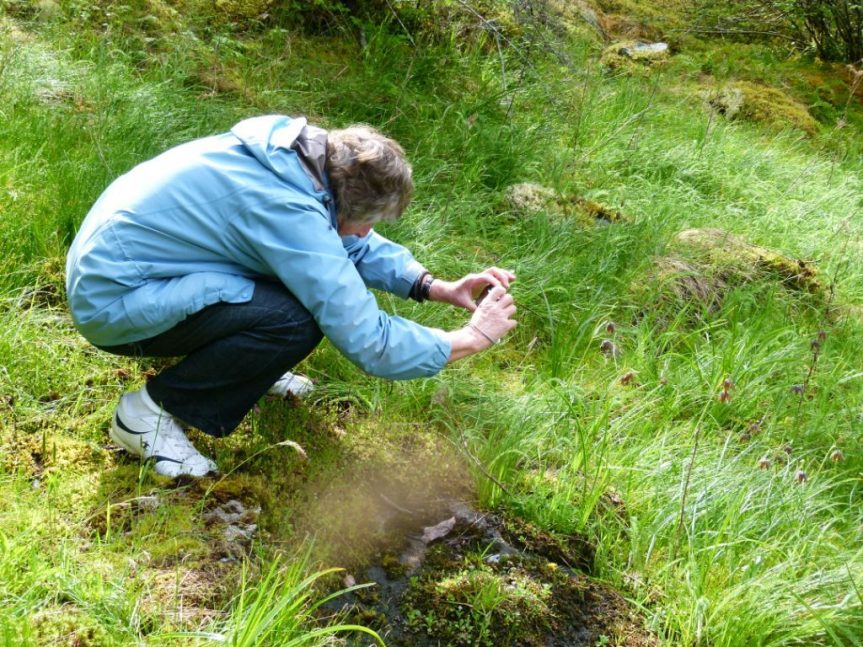
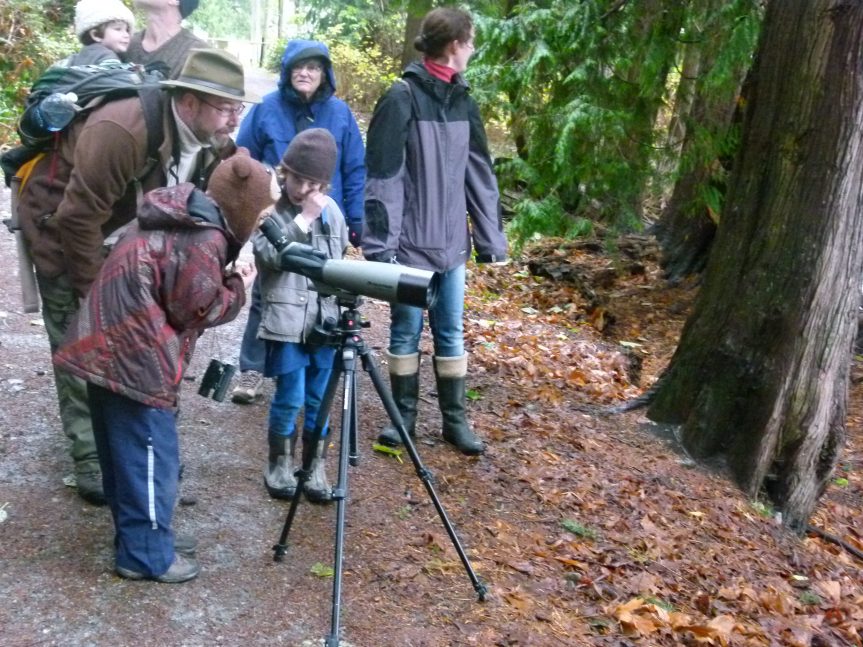
Ten members met Pierre Geoffray at the Italian Hall in Wildwood and immediately we began listening for birds. We encountered several migrant flocks passing through the area. Warblers of many varieties sang out, and we were delighted to spot orange-crowned, black-throated grey, and Townsend’s as well as a warbling vireo who gave us a sweet generous trill.

We spotted only a fraction of the birds that we heard, underlining the importance of learning to bird by ear. But the grand finale, a pair of enormous bears, reminded us that we shouldn’t keep too quiet out there either.

Cedwyn Phillips – “South Georgia and Antarctica”

Cedwyn Phillips – “South Georgia and Antarctica”
by Andrew Bryant, 23 Apr 2014. 

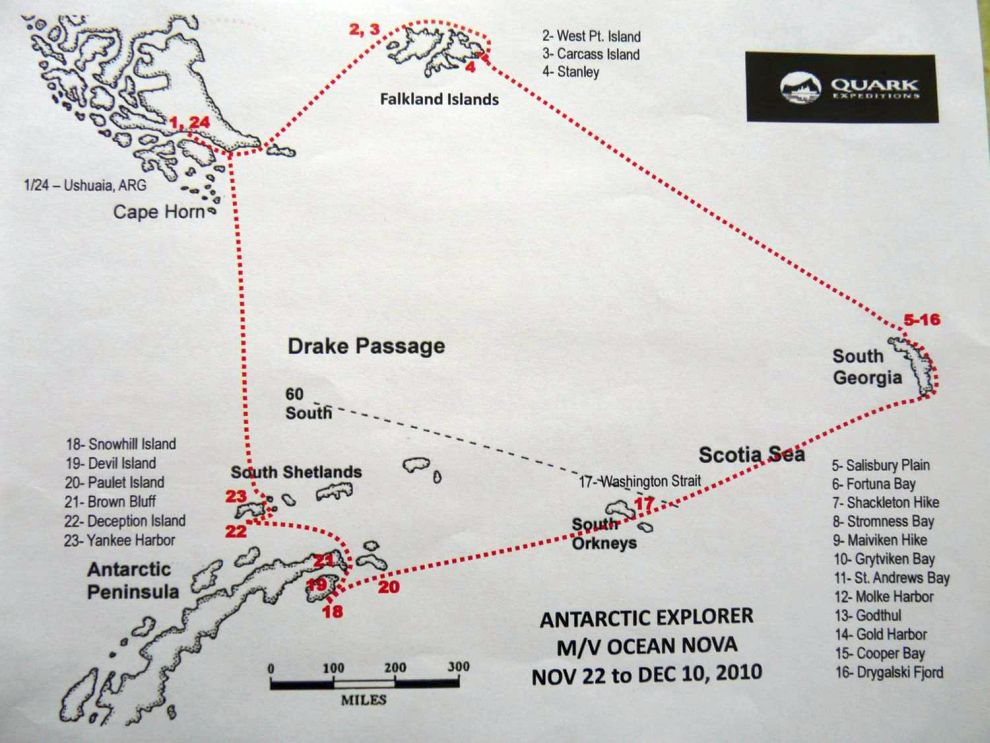
Track of the MV Ocean Nova, 22 Nov – 10 Dec 2010
Click on the image to enlarge

Cedwyn is from London, England but now calls Powell River home.

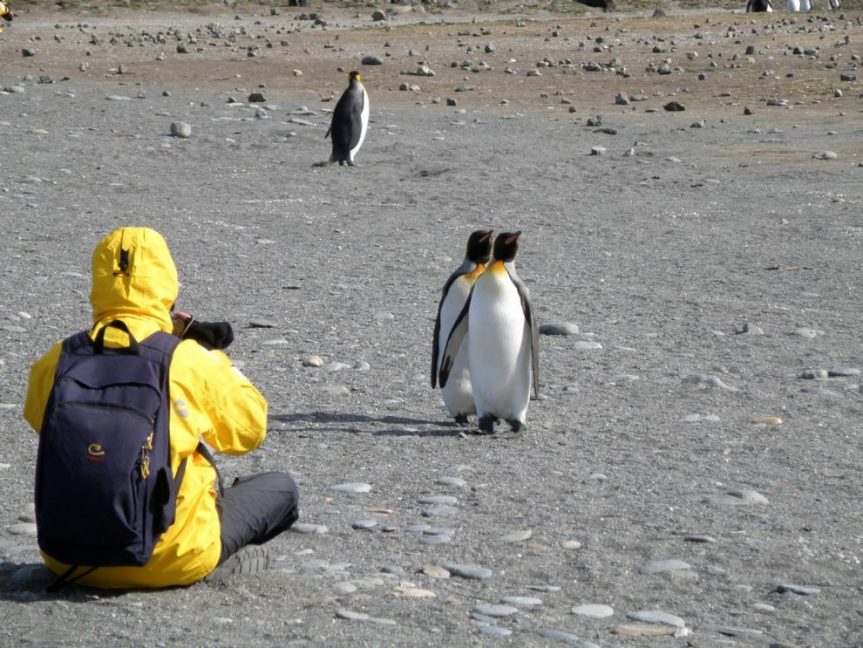
In 2010 he and his wife Peggy spent 18 nights aboard the M.V. Ocean Nova as it traveled from Ushuaia, Argentina to the Falklands Islands. From there they cruised south, touring several spots on South Georgia, before going even further south – to the northern tip of Antarctica!

Judging from the map, you can imagine that must have been quite the trip.   And so it was.   It’s our privilege to share some of the slides we got to see.

Cedwyn may be soft-spoken, but his images speak volumes – enjoy the trip!

[metaslider id=15728]

David Atkinson – “Pacific Storms”

David Atkinson – “Pacific Storms”
by Andrew Bryant, 28 March 2014. 

David Atkinson, a professor of Geography at the University of Victoria, provided an overview of storm activity in the North Pacific Ocean – types of storms, where they form, why they grow, where and how they travel, where they die, impacts they can exert, and particular features of the Pacific West Coast, including a phenomenon known as “Atmospheric Rivers” or, in more casual terms, how the “pineapple express” actually drives our local weather patterns.

He also spoke about how the research enterprise works, and what some of his graduate students are doing.  His graphics were astounding, and showed just how huge some of these storms actually are.

He spoke for an hour, but given his vast knowledge and obvious passion for the subject, we think he could have gone on for longer had we let him!

Twigs and more with Shirley Cole

Twigs and more with Shirley Cole
by Heidi Rohard, 20 February 2014.

Shirley Cole led a group of seven on a nature walk along some Squirrel Crossing trails.

She pointed out to us various twigs, such as huckleberry, hardhack, salmonberry and pacific crabapple.  We learned the difference between a yew and a hemlock and can now identify bunchberry, oregon grape and salal.

This walk was very enjoyable (not too cold) and we appreciate Shirley’s knowledge and enthusiasm.

A follow-up trip is planned for April to revisit the trails and see these shrubs and trees in spring foliage.  This trip was a repeat of one held some years ago and some of the people who went then have expressed interest in the April version.

Heather Harbord – “Mitlenatch Island”

Heather Harbord – “Mitlenatch Island”
by Andrew Bryant, 20 Feb 2013. 

Heather, Claudia Boelke  and Janet Southcott shared images and anecdotes of lovely Mitlenatch island and its rich wildlife.  The club has run day trips there aboard Misty Isles for several years, including another successful visit in May 2013.

We learned what it was like to live on the island for a week, and about the scientific programs in which the wardens participate.

2nd Christmas Bird Count for Kids

2nd Christmas Bird Count for Kids
by Elizabeth Tenhoeve, 7 Dec 2013.

Once again a few of us braved the wilds of Willingdon Beach and added to our birding identification skills.

 We’re pleased that our kids are participating in the Audubon Christmas Bird Count – and having fun in the process!

Dan Blower – “Mountain Goats”

Dan Blower – “Mountain Goats”
by Sherri Wretham, 21 November 2013. 

Dan Blower, who is a retired B.C. Wildlife Branch ungulate specialist, spoke on the natural history of mountain goats and their distribution and abundance in the province.  

His talk was illustrated with numerous maps and slides of Mountain goat habitat types in the province.   We were captivated by the power and grace of these majestic animals.

Princess Louisa Inlet

Princess Louisa Inlet
by Heather Harbord, 5 November 2013.

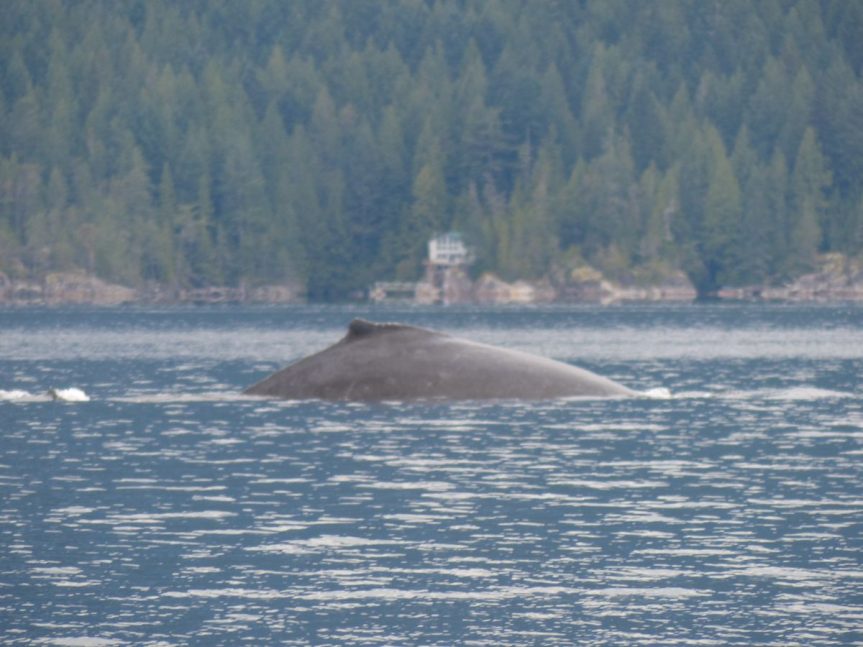
Eleven of us boarded John Dafoe’s comfortable power boat at the government dock at Saltery Bay.  As we drew into Hotham Sound,  we saw the hump and dorsal fin of a humpback whale.  As we lingered to watch several of us got good pictures of the fin, the blow and the tail.

At 18 knots we proceeded into Jervis Inlet past sea lions, seals and marbled murrelet pairs.  John pointed out features of interest including  pictographs, hanging valleys and a high cliff of vertical rock strata.  We saw one goat chewing the cud high up on Marlboro Bluffs.  At the inner end of the rapids into Princess Louisa Inlet, there was a large group of several hundred Barrow’s Goldeneye ducks.  Malibu Camp was our first stop.  After a tour of the beautifully constructed log cabins we reboarded the boat and found ourselves the only boat at the Chatterbox Falls.  (In summer boats are four deep all along the 100 meter dock).  The moss on the trees on the trail up to the falls was spectacular as the atmosphere there is always moist.

On the way back down Jervis Inlet, the sun peeped through the clouds letting us see the snow-covered tops of some mountains.  The trip ended with a run out to the McRae Rocks off Frolander Bay to see the sea lions.  As we left the two-days old new moon appeared.

Susan MacKay – “Pinnipeds: Seals and Sea-lions”

Susan MacKay – “Pinnipeds: Seals and Sea-lions”
by Heather Harbord, 24 October 2013. 

Susan MacKay is the founder of Whales and Dolphins BC and President of the non-profit Wild Ocean Whale Society (WOWs).  She is also a member of the Marine Mammal Response Network, a group that responds to reports of injured, distressed or dead marine mammals.

Susan spoke about Pinnipeds, the group of marine mammals that have front and rear flippers such as seals, sea lions and walrus.   Of the 33 species globally, there are five species of Pinnipeds that frequent our local BC waters while a few of the others migrate through our waters, to and from their breeding grounds.  While some of these are considered true seals, some are not.

Apart from local species information, Susan spoke about their cute and quirky behaviors, as well as specifics of how they relate to nature’s balance in our oceans.

Mushrooms

Mushrooms
by Michael Stewart, 20 October 2013.

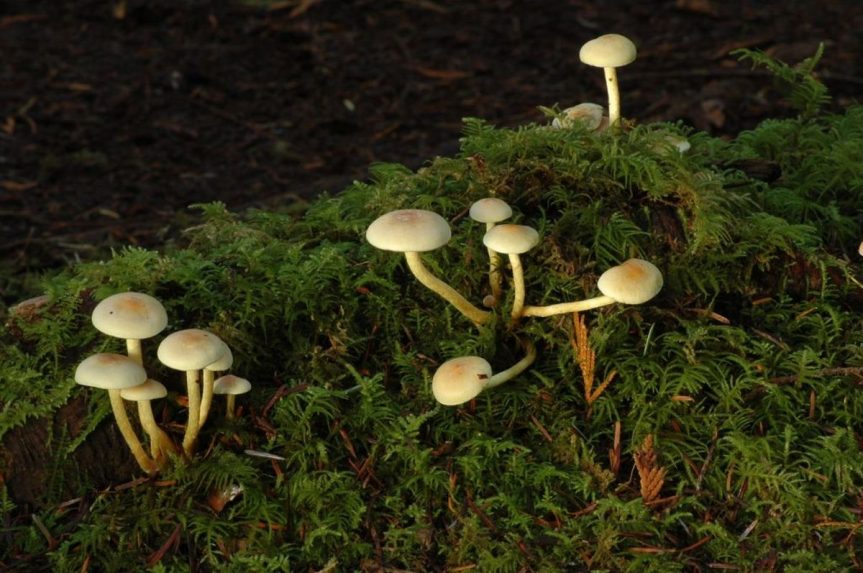
Twenty-nine eager participants arrived to learn about Mushrooms from Izi Loveluck.  We met and carpooled from the Town Center Mall or the south end of Duck Lake Road and travelled to Squirrel Crossing.

We walked the short distance to the bridge crossing the river and then Izi gave us a well informed talk on the basics of wild mushroom Identification as well as their relationship with other plants and their characteristics.  Claudia Boelcke had collected many specimens the previous day and had them on display when we arrived.  After Izi’s talk, we spread out from the campsite in small groups to observe and collect specimens.  When we returned, we had gathered many specimens of many species.  David Bedry borrowed Andrew Bryant’s cookstove and we were fortunate to have Janet May able to light it for us.

We cooked many edible samples of mushrooms including chanterelles, hedgehogs, and boletes.  Izy later identified the bolete we ate as Boletus mirabilis not edulis because edulis has a much thicker stalk and the Admiral Bolete has a “lemony” taste as reported by several tasters!   As well, the caps are different with edulis having a whitish dusting and mirabilis without”.   Claudia also brought home smoked bacon with which to cook some of the mushrooms and Michael Stewart supplied homemade bread.  Most of the participants sampled some wonderful wild mushrooms!  At the same time, a note of warning came from Nick Houser who circulated details of the Amanita Smithiana mushroom that a Savary Island resident last year wrongly identified as an edible pine with almost near fatal consequences.

 Izi’s recommended book list:
  • All That the Rain Promises and More.  David Arora.  0-89815-388-3
  • Common Mushrooms of the Northwest.  J. Duane Sept.  0-9739819-0-3
  • Edible Wild Mushrooms of North America.  David W. Fischer and Alan E. Bessette.  0-292-72079-3
  • Mushrooms of the Pacific Northwest. Steve Trudell and Joe Ammirati. 978-0-88192-935-5
  • The Complete Mushroom Hunter.  Gary Lincoff.  978-1-59253-615-3
The first two are small, portable, guides.  The 3rd lists similar species and contains recipes.  The 4th  describes the latest classification system— and is written by two UW professors.  The last has some great general information.

Lang Creek salmon

Lang Creek salmon
by Heidi Rohard, 5 October 2013. 

A group of 15 club members met at the Lang Creek spawning channel on Saturday.  The weather was overcast, but dry and not too cold.  Michael Stewart started off by explaining the work that had been done by volunteers of the Powell River Garden Club, creating a beautiful setting of native plants around the parking lot of the spawning channel.

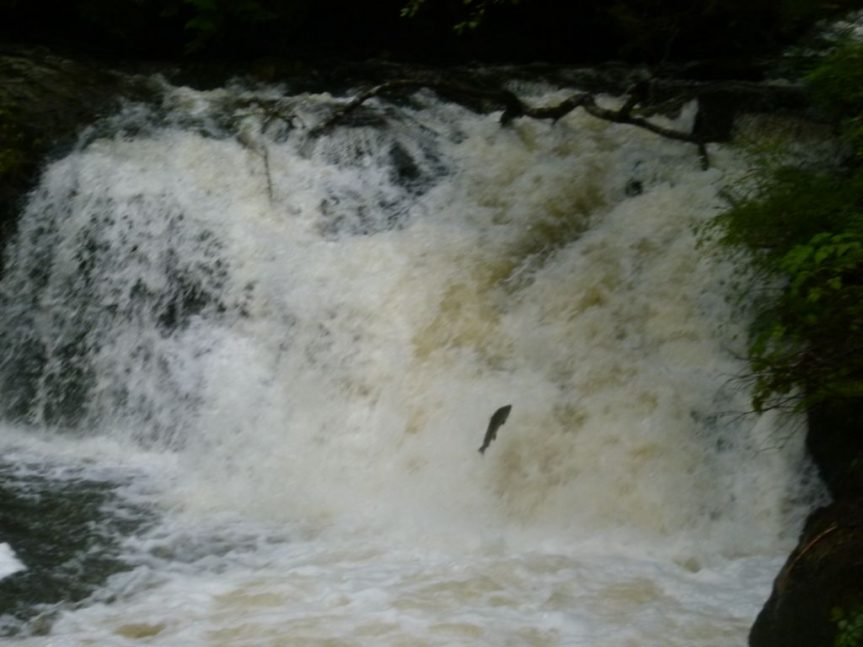
We then walked over to the creek, and while watching the Pink salmon trying to swim up-stream, David talked to us about the various times that the species of salmon make their appearance, and the life cycle and spawning behaviour of salmon.  We saw a few trout in the channel as well.  The whole stream was of course littered with carcasses, which provide nutrition not only for bears (we didn’t see any) and birds, but also for the young salmon.

There were no hatchery staff available to allow us entry into the counting and sorting facility, but David explained the procedures to us.  We all appreciated his informative talk.

Nine of us drove to the bottom of Duck Lake Road and then car-pooled to the Lang Creek hatchery. After a short walk from the gate we arrived at an observation platform and saw a beautiful waterfall, not really that high but too high for the salmon.  Some would try to reach the top but would not make it and spawn in the fall’s pool instead.

It was a great short field trip.

Rob Hope – “Raptors”

Rob Hope – “Raptors”
by Sherri Wretham, 25 September 2013. 

Rob Hope is the senior rehabilitator at Orphaned Wildlife Rehabilitation Society in Delta.  O.W.L. is one of the premier raptor rehab centres in North America and has featured on the television program Hope for Wildlife. Specializing in raptors, the facility cares for injured and orphaned birds of prey ranging from the tiny pygmy owl to the majestic golden eagle.

Rob gave insights into the quirks and personalities of each species, both in care and in the wild.  An avid outdoorsman, he knows the habitats and conditions required for each species, and has advised on provincial protection and recovery programs, such as the one for the spotted owl. 

He spoke about various aspects of raptors (owls, hawks, eagles and vultures) in the wild,  and answered questions about the species commonly seen in Powell River.

Banding Purple Martins Part II

Banding Purple Martins Part II

by Elizabeth Tenhoeve, 5 Aug 2013.

Quite a crowd turned out for what is becoming an annual event.

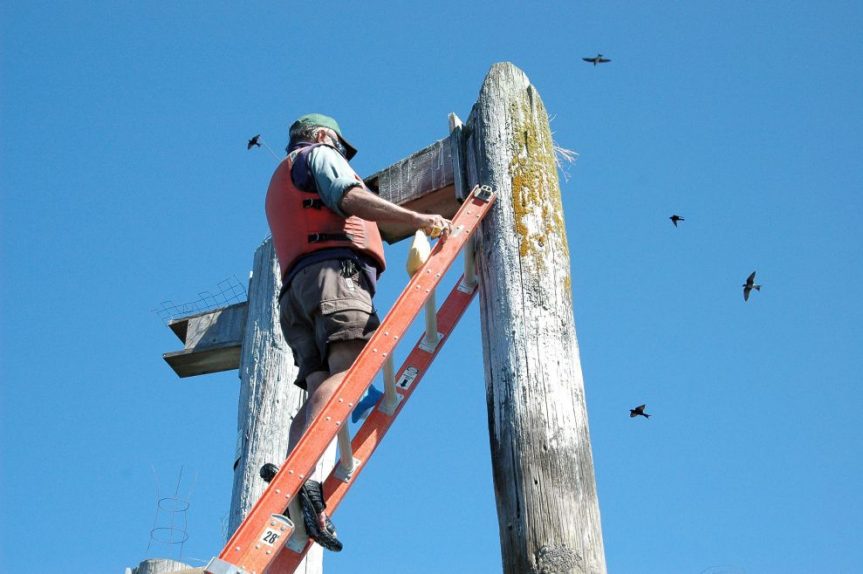
At Myrtle Rocks we have one of the northernmost colonies of Purple Martins, birds of the swallow family who nest in the boxes attached to offshore pilings.   We watched the nestlings as they were removed from the nest, banded, and assessed for age, then put back into the nest.

These birds migrate huge distances, so the banding helps to keep track of what journeys the birds have made.

Dragonflies

Dragonflies
by Sharon Godkin, 30 July 2013.

Five members jammed into Barbara Sherriff’s car on the noon ferry to Comox to meet our February speaker, Terry Thormin, for a dragonfly field trip.

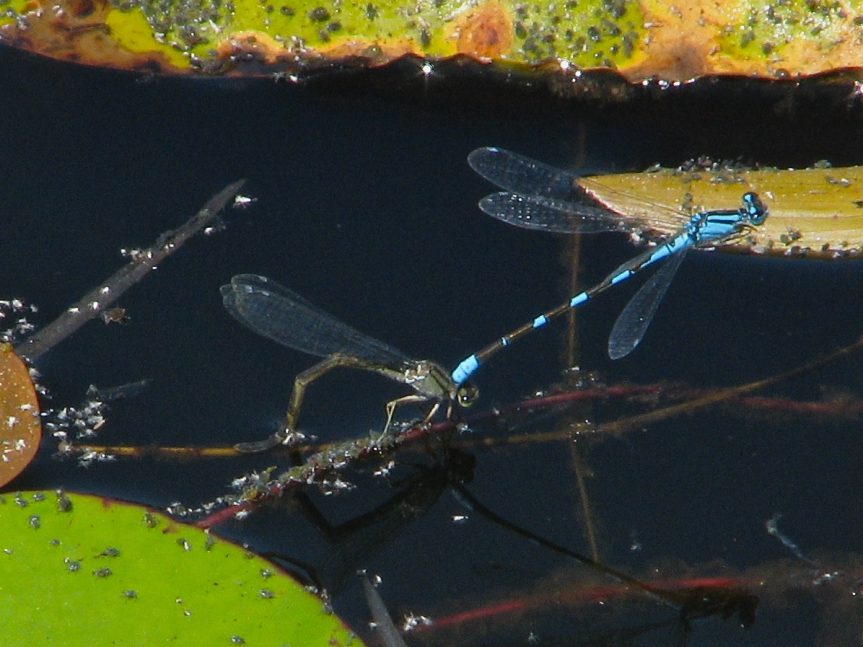
By the time we arrived at Little River Park near the ferry terminal, the dragonflies were in full form skimming over the two ponds in the hot sunshine.  Their flashes of colour were complemented by the background greens and coppers of the floating leaves of the Yellow Pond-lily Nuphar polysepalum, Floating-leaved Pondweed Potamogeton natans, and Watershield Brasenia schreberi, and the bright yellow emergent flowers of the Yellow Pond-lily.  We had excellent views of 8 species of dragonflies and two of damselflies.  A pair of Tule Bluet Damselfies deposited eggs onto the stems of the Floating-leaved Pondweed and Watershield nearly at our feet.  Terry also pointed out Pacific Forktail Damselflies Ischnura cervula.  The large darners: Common Green Darner Anax junius, Blue-eyed Darner Rhionaeshna multicolor, Canada Darner Aeshna canadensis and the skimmers: Fourspotted Skimmer Libellula quadrimaculata, and Eight-spotted Skimmer Libellula forensis, constantly patrolled over the water, never alighting for a photo.  The meadowhawks: Cardinal Meadowhawk Sympetrum illotum, Striped Meadowhawk Sympetrum pallipes, and the Blue Dashers Pachydiplax longipennis were much more cooperative, posing on top of sticks and sedges.  Terry pointed out the characteristic way in which the Blue Dashers and other dragonflies, but not damselflies, hold their wings at rest, angled forward and downwards rather than out to the side as other dragonflies do most of the time.

Next Terry piloted us up the Strathcona Parkway to a small bog 9 km up the slopes of Mt. Washington to see the species that prefer higher elevation habitats.  Entering the bog via a deep ditch, we were greeted by a drift of the spectacular blue King Gentian Gentiana sceptrum spangled with White Swamp (Douglas) Gentian Gentiana douglasiana, the maroon globes of Great Burnet Sanguisorba officinalis, green spires of Slender Bog Orchid Platanthera stricta, white twisted spikes of Ladies’ Tresses Spiranthes romanzoffiana, and the erect red capsules of Sticky False Asphodel Tofieldia glutinosa, all in a carpet of Deer Cabbage Fauria crista-galli and Great Burnet leaves.  The shallow central pond appeared farther into the bog, studded with emergent Buckbean Menyanthes trifoliata with a few showy white flowers, and a few Yellow Pond-lily leaves.  It was rimmed by colourful Spagnum mosses and two species of sparkling dewy red carnivorous plants: the Round-leaved Sundew Drosera rotundifolia and the Great (long-leaved) Sundew Drosera anglica.  Some Western Bog-laurel Kalmia microphylla ssp. occidentalis plants still had a few rose-pink saucer-shaped flowers.  Whorls of the pale green follicles of Fern-leaved Goldthread Coptis asplenifolia fanned above mats of its shiny deep green finely-dissected leaves, which were mostly hidden beneath the glaucous-green leaves of Bog Blueberry Vaccinium uliginosum.  These were often clustered around the bases of the dwarfed conifers, Mountain Hemlock Tsuga mertensiana and Yellow-Cedar Chamaecyparis nootkatensis.  Three new species of dragonflies and some newly emerged Spreadwing damselflies (likely Spotted, Lestes congener) entertained us here.  The striking Crimson-ringed Whiteface dragonfly Leucorrhinia glacialis basked on the Buckbean leaves, while the Sedge Darner Aeshna juncea whizzed by.  The Ringed Emerald Somatochlora albicincta made multiple passes, but paused to hover briefly so we could enjoy its brilliant emerald eyes.

After Barbara and Liz left for Nanaimo, Terry drove the rest of us to the Griffin Pub in Comox, where we treated him to dinner.  He ended this wonderful field day by delivering us to the 7.15pm ferry to Powell River, for which many thanks.  Don’t forget to visit Terry’s photography site to see his fantastic photos at http://terrythormin.smugmug.com 

Hernando Reef

Hernando Reef
by Andrew Bryant, 22 July 2013.

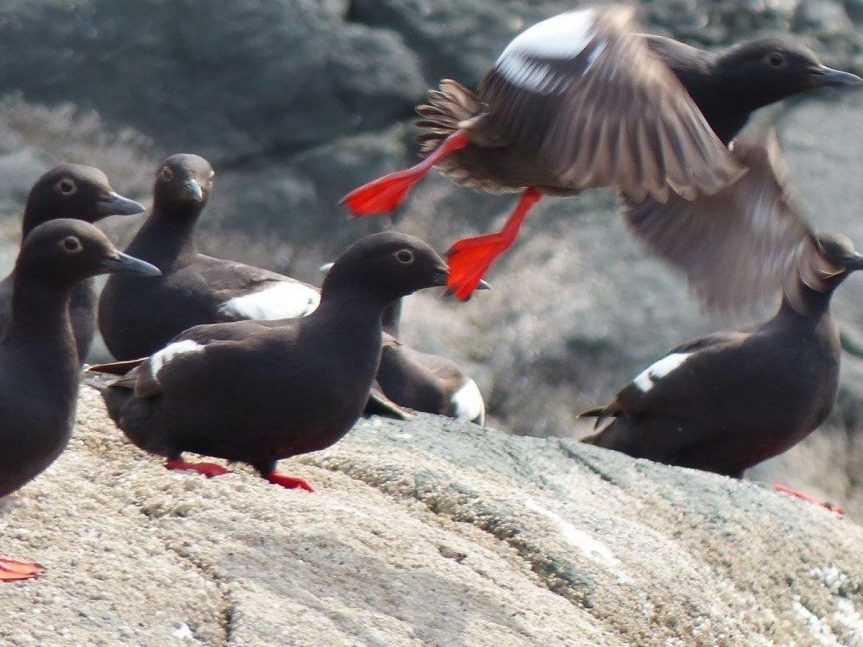
Twelve of us embarked upon the Misty Isles in Lund and set out for the unknown (at least to me) waters surrounding Hernando Island.  Luckily Mike Moore AKA “Captain Mike” clearly knew his stuff and made us feel comfortable and safe.  The skies were clear and the ocean blue.  We saw a few harbor porpoises and pigeon guillemots en route.

After about an hour and a half we set anchor, transferred to the Zodiac and zoomed ashore.  I’m glad we brought ski-poles because the footing was absolutely treacherous.  Sabina soon began to display her encyclopedic knowledge of the intertidal zone and the amazing diversity of critters that call it home.  My word!  Sea stars, nudibranches, barnacles, limpets, crabs of all shapes and sizes, kelp, more crabs, and my personal favorite the Encrusting red sponge.  Sabina not only knew them all by name, she seemed to have intimate knowledge of their varied anatomies and sexual proclivities.  Hmmm…

I’m glad I brought my mask and snorkel, because if life above water was interesting, underwater was astounding.  I vividly remember getting very close to a curious harbor seal, and watching the northern kelp crabs weaving strands of eelgrass together as they climbed towards food incoming with the tide.

Which almost stranded the lot of us, by the way.  More than once.  Great good fun.  Go if you get the chance.

Westview seashore photography

Westview seashore photography
by David Bedry, 22 June 2013.

With a one foot tide five of us met Heather at the foot of Masset Street.  We walked out onto the beach from there to look for various saltwater flora and fauna.  There were a variety of small crab in the 1-2 inch deep water.  As soon as they detected motion from us they either scurried away or dug themselves into the sand.  We also saw orange and purple sea stars and a few leather stars.  One bald eagle, four turkey vultures and numerous Glaucous-winged gulls were feeding on some salmon heads and entrails courtesy of a successful salmon fisherman.

As far as photography was concerned I showed the group the way a polarizing filter reduces the glare from the water and wet seaweed and creatures.  I enjoyed myself snapping pictures of the group the tidepool life and making artsy compositions of the rocks seaweed and sand.  Before we knew it an hour and a half had flown by while Heather educated us to the marvels of life at low tide.

For me it was a very enjoyable zero expense trip.

Mitlenatch visit

Mitlenatch visit
by Heather Habord, 15 June 2013.

Participants not only got to visit the island, they get there on the trusty Misty Isles with Mike Moore.   Mike is an expert captain who shared all kinds of coastal stories.   His wife is the botanist who led the on-shore trip.   The spring flowers were out in all their glory – tiger lilies, blue-eyed grass, death camas, Oregon sunshine etc.   Gulls, cormorants and guillemots were nesting and visible from the specially-constructed bird blind.

As volunteer wardens, Claudia Boelke, Janet Southcott and I were already there to greet everyone.   As usual, half the group went ashore with the naturalist to look at the wildflowers and nesting areas, while other half circled the island in the zodiac to get close up views of seals, sea-lions and the cormorant rookery.

The weather was glorious.  We weighed anchor about 3pm and were back in Lund just after 5:30pm.   The cost per person was $131.25.

Savary beaches and spring flowers

Savary beaches and spring flowers
by David Bedry, 11 May 2013.

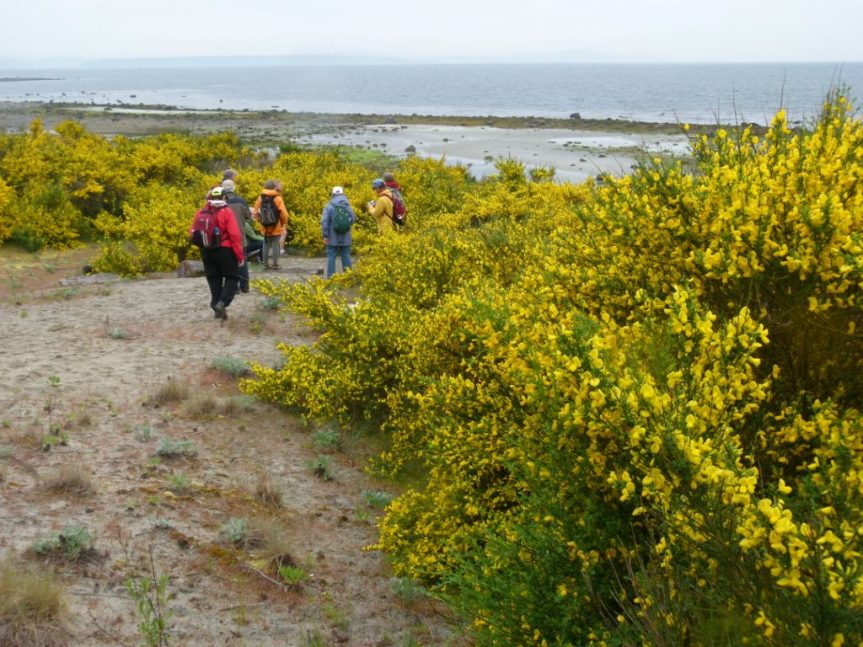
Eleven people met in Lund to take the water taxi over to Savary Island.  We were met by the Treen’s who had scouted out and marked various wild flowers for us to see.  We started with a nice walk along the beach then John directed us up off the beach and into a mostly pine forest.  This is where they had marked various locations with coral root.  Another spot had a pair of cone flowers.  We continued up through the forest to the old deactivated air strip.  From here we worked our way along roads and trails over the sand dunes to drop down through scotch broom down to the beach on the south side of the island.  After walking the beach for a short distance we walked inland to the road.  This is where Joan rescued us for a lunch break.  We stopped and used the picnic tables at the church.  A very quaint building.

Continuing on roads and trails we worked our way up to the Treen’s place for coffee and tea.  We all appreciated both John and Joan’s construction, handywork and gardening skills.  This is where the threatening skies finally opened up.  It was great to enjoy our coffee and visiting out of the rain.  On the way back to the water taxi we worked our way through the forest and back to the water on the north side of the island.  This is where we found the northernmost Gary oak as well as some columbine and chocolate lilies.  A great day especially for my first trip to Savary Island.  Thank you very much John and Joan!

Birding by ear Part III

Birding by ear Part III
by Heather Harbord, 20 April 2013.

Four of us met Pierre at the Italian Hall and walked north along a muddy trail where we saw or heard 29 species.

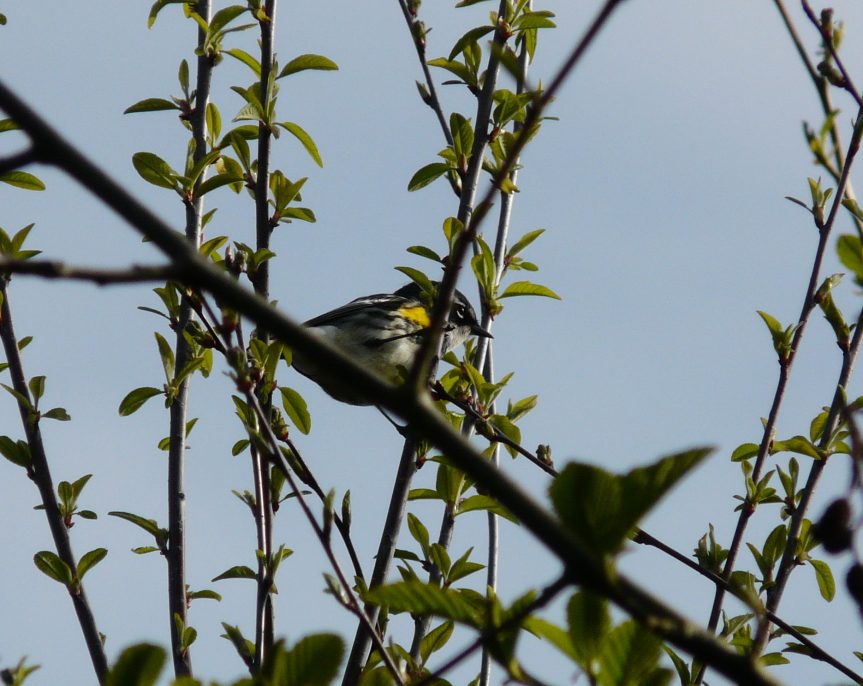
We mostly focused on the Orange-crowned Warbler’s song.  The long, thin trill that drops at the end.  Luckily there were lots of them today.  Also the “wetchidi-witchidi” of the newly arrived Common Yellowthroats.  There was a nice movement of Yellow-rumped Warblers.  We saw a beautiful ‘Myrtle’ form of them, pausing above us for all to admire.  A merlin swooped by, low over the bushes, with a Rufous Hummingbird hot in pursuit.  Those little guys are really bold!

There were still flocks of Greater White-fronted Geese flying over and 3 Blue-winged Teals showed up briefly headed for the shore.

Doug Corrin – “Mountain pine beetles”

Doug Corrin – “Mountain pine beetles”
by Andrew Bryant, 18 April 2013. 

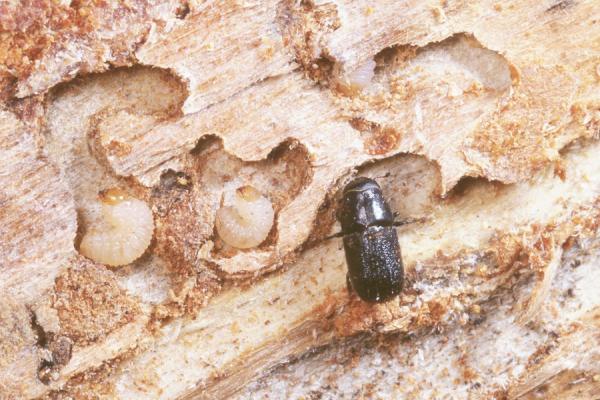
Doug Corrin is Professor of Forestry at Vancouver Island University in Nanaimo.  He spoke about the biological adaptations of the mountain pine beetle, and how they enabled it to become the largest insect epidemic in North American history.

Doug also discussed how recent weather patterns, and past firefighting efforts, have contributed to this outbreak.  We learned that it is not just Mother Nature who is to blame!

In a first for us, Doug has kindly made his complete Powerpoint presentation available here.  Enjoy!


Fawn Lily Extravaganza

Fawn Lily Extravaganza
by Heather Harbord, 7 April 2013. 

White avalanche lilies, or fawn lilies (Erythronium montanum)  are at the northern edge of their range in coastal British Columbia.  How they might have reached Sliammon is a bit of a mystery.  Our trip was ably led by Andrew Bryant and Rod Innis.

Although the mystery of disjunct geographic distribution remains unsolved, the nine of us really enjoyed rambling through the extensive field of showy white lilies.

Goats and Eldred River geology

Goats and Eldred River geology
By Heather Harbord, 23 March 2013.

Several carloads of us drove up to Goat Lake where we viewed about 4 goats from the viewpoint.  A short hike through the woods took us past the climbers’ camp and out onto the river bank where we ate lunch and enjoyed the rushing water.  Geologist Barbara Sherriff expounded on the local mineralogy.

Some of us drove up to the end of the road which was further on than when we came last year but again ended in a culvert outage.

On the way back we saw more goats through the scopes.

Eileen Van Der Flier-Keller – “The rock story”

Eileen Van Der Flier-Keller – “The rock story”
by Andrew Bryant, 21 March 2013

Dr. Eileen Van Der Flier-Keller is a geologist from the School of Earth and Ocean Sciences at the University of Victoria, and the author of A Field Guide to the Identification of Pebbles.  

She really likes rocks!  

Her talk illustrated how time and enormous pressures have combined to produce the unusual geology of Vancouver Island.

Terry Thormin – “Dragonflies of Vancouver Island”

Terry Thormin – “Dragonflies of Vancouver Island”
by Sherri Wretham, 28 February 2013. 

Terry Thormin spoke to us about the Dragonflies of Vancouver Island.   Did you know that there are 41 species of dragonflies on Vancouver Island?  We didn’t.

Terry spoke on the biology, behavior and habitat of Dragonflies.   He illustrated his talk with some of his excellent photographs, many more of which can be seen at his blog, which can be found here.

Texada Quarry

Texada Quarry
By Heather Harbord, 16 February 2013.

Twelve of us, including Barbara Sherriff (Leader) and myself (Coordinator), walked on the 9:50 AM ferry to Texada.  On board, Barbara explained how limestone is formed from marine sediments and how igneous intrusions into it produced small deposits of gold, silver and copper.

At Blubber Bay, retired quarry manager, Harold Diggon, and TQL’s Quarry Maintenance Manager, Warren Kiland met us with a bus.  The Blubber Bay Museum was the first stop.  Texada Heritage Society Chair, Ken Barton, and Texada Archivist, Doug Paton, opened the doors to show off the mining and mineral displays.  A quick bus tour of Van Anda showed the group the remains of early twentieth century lime quarry and kilns at Limekiln Bay as well as the 1897 kiln at Marble Bay.  The group stopped at the Ravenous Raven which was kindly hosted by the quarry.

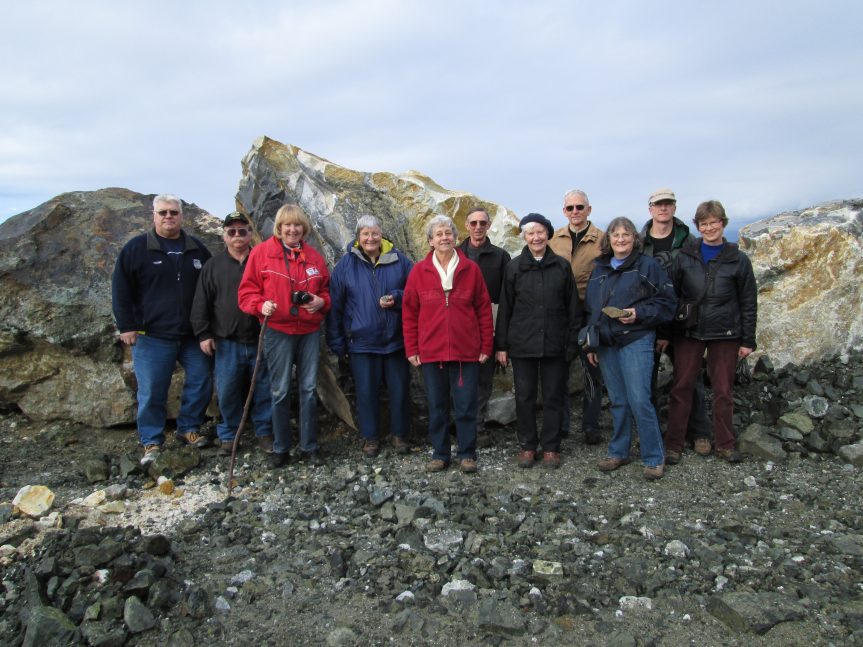
At the quarry, we stopped to look at some recently blasted flower rock and then went up to the 820 level where the clouds cleared enough to provide a stupendous view over Texada and across the water to Powell River and Vancouver Island.  We collected some lovely samples of iron pyrites associated with quartz and posed for a group photo.  The day ended with a quick run back to catch the 3:00 PM ferry.

Rob Crookshank – “Forest Fire!”

Rob Crookshank – “Forest Fire!”
by Sherri Wretham, 31 January 2013. 

Rob Crookshank, a resident of Powell River and an Air Attack Officer for the Ministry of Forests, spoke about current trends in fire activity in B.C., and about how the Ministry is trying to manage the situation.

He described new approaches to wildfire control using Power Point and video.  He’s been in the “fire business for 25 years” and was happy to answer questions.

First Christmas Bird Count for Kids

First Christmas Bird Count for Kids
by Janet Southcott, 1 Dec 2012.

This is the first year our Young Naturalists have participated in a nationwide bird count.

We were thwarted by the weather, high winds, rain, not ideal conditions for bird watching.  But a few brave souls came out to help.

We worked with experienced birders and walked through Millennium Park.  Everyone learned how to use binoculars and the names of birds seen during the count.

David Bedry – “Nature Photography”

David Bedry – “Nature Photography”
by Sherri Wretham, 29 November 2012. 

David gave a presentation on nature photography.  As his presentation was sure to wet the appetite of many in the audience to dust off their own cameras, David followed up by leading a subsequent field trip.

David covered many of the basics that we often forget about, including the relationship between f-stops and aperture, using tripods, polarizing filters, and the like.  Most of all he shared more of his own stunning photographs.  Thank you David!